Topics
Microwave cooking does not make food radioactive. It transfers energy into the food, raising its temperature. The meal can remain hot after the oven stops, but it has not become a source of radioactivity because it was microwaved. Health Canada's explanation.
That is the useful starting point when a social-media post claims otherwise. The next step is to explain the distinction, because the word radiation does real work in the misleading argument.
The reasoning often takes this form: microwaves are radiation; radioactive materials emit radiation; therefore microwave cooking makes food radioactive. The first two statements do not establish the third. They connect different physical processes through a shared word.
Radiation describes more than one thing
Visible light and microwaves are both electromagnetic radiation. Calling something radiation tells us that energy is being transferred; the word alone does not specify the frequency, intensity, interaction with matter, or resulting risk. The FDA distinguishes microwave radiation from the ionizing radiation associated with X-rays. FDA explanation of microwave ovens.
Radioactivity has a more specific meaning. Unstable atomic nuclei undergo decay and emit radiation. That process can continue without an external appliance supplying power. The US Nuclear Regulatory Commission's definition concerns spontaneous decay, not the general fact that an object has absorbed energy.
Three questions therefore need to stay separate:
| Question | What it concerns |
|---|---|
| Is energy arriving as electromagnetic radiation? | How energy reaches an object |
| Is the object heating up? | How absorbed energy changes its thermal state |
| Has the object become radioactive? | Whether unstable nuclei are undergoing radioactive decay |
Saying yes to the first two does not answer the third. A claim that moves between these rows needs to supply the missing mechanism.
A comparison we can calculate
The energy of one photon, a quantum of electromagnetic radiation, depends on its frequency. Higher frequency means more energy per photon.
Take a representative microwave frequency of 2.45 gigahertz. This is the frequency around which NIST recorded emissions from the microwave ovens in its measurement dataset. Compare it with green light at a chosen wavelength of 550 nanometres.
Using the physical constants defined in the SI gives:
| Example | Energy of one photon |
|---|---|
| Microwave at 2.45 GHz | About 0.0000101 electronvolts |
| Green light at 550 nm | About 2.25 electronvolts |
An electronvolt is a small unit of energy convenient for this scale. The important comparison is the ratio: the green-light photon has about 222,000 times more energy than the microwave photon in this example.
That result gives the word radiation some scale. Microwaves and visible light belong to the same broad electromagnetic spectrum, while transferring very different amounts of energy per photon.
It is not a ranking of every possible danger. Concentrated visible light can be hazardous, and intense microwaves can heat tissue. A comparison of individual photons leaves out how much energy arrives, where it is absorbed, and for how long.
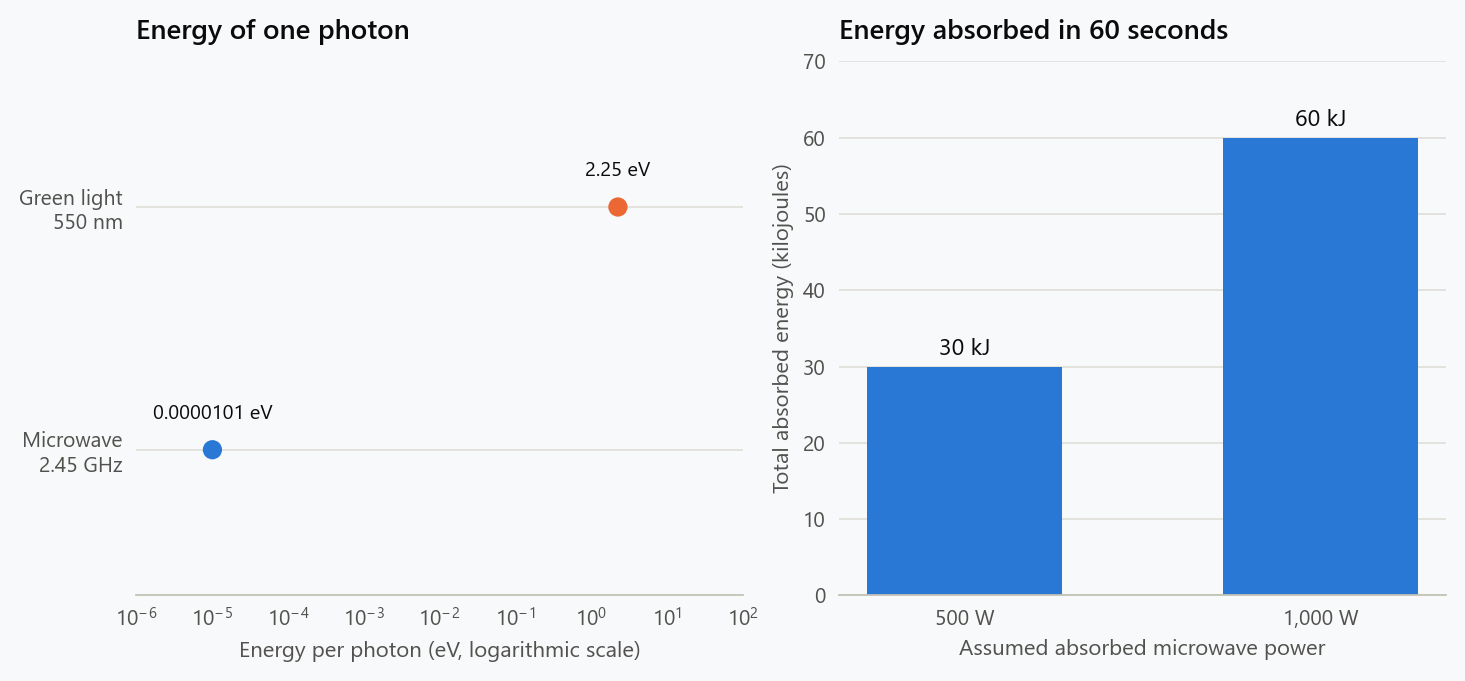
Original calculations. The left axis is logarithmic: equal horizontal distances represent equal multiplicative changes. The right panel assumes constant absorbed power; it is not a measurement of a particular oven or meal.
How can such low-energy photons heat a meal?
There is no contradiction between a small energy per photon and a large total energy transfer. The number of photons matters too.
Imagine that food absorbs microwave energy at a steady rate of 500 watts. A watt is one joule per second, so after 60 seconds the absorbed energy is
At 1,000 watts of absorbed power, the same calculation gives 60,000 joules. The photon energy stays the same if the frequency stays the same. The rate of energy transfer has doubled.
For the 500-watt example, the equivalent number of absorbed 2.45-GHz photons is about $3.08\times10^{26}$ per second. A very small contribution repeated an enormous number of times can supply substantial energy.
These assumed absorbed powers are not necessarily an appliance's electrical power consumption or its labelled cooking output. Nor do the calculations give a cooking time: a temperature prediction would also require the food's properties, the distribution of absorption, and energy losses.
The point is narrower. Turning up the power does not turn each microwave photon into an X-ray photon. It changes the energy delivered per unit time. The heating effect can become stronger while the frequency remains in the microwave range.
Heating and radioactivity have different mechanisms
In food, the changing electromagnetic field interacts with matter, including water molecules, and absorbed energy is transferred into thermal motion. Microwave cooking uses this heating process. The FDA describes the resulting energy conversion and explicitly states that it does not make the food radioactive. FDA explanation.
The distinction between ionizing and non-ionizing is also useful, but should be used precisely. Ionization concerns removing electrons from atoms or molecules. Radioactivity concerns nuclear decay. Those are different processes too; treating them as synonyms introduces another mistake into the explanation.
Our photon calculation illustrates the energy scale. It is not, by itself, a complete analysis of nuclear reactions or every interaction between radiation and matter. The specific conclusion about ordinary microwave cooking is supported by how the appliance transfers energy and by the agency explanations linked here.
When the oven stops generating microwaves, those microwaves do not remain stored in the meal. Heat can remain, just as a mug stays warm after another heat source has been removed. Health Canada.
The useful safety questions are more concrete
Rejecting induced radioactivity does not establish that every use of every microwave oven is safe. It lets us ask about the relevant conditions.
Hot food, containers, and superheated liquids can cause burns. Containers should be suitable for microwave use and used according to their instructions. These are among the issues addressed in the FDA's operating guidance.
Food can also heat unevenly. A study of products requiring cooking before consumption examined how microwave preparation can leave regions below the required temperature. A hot patch is therefore not evidence that an entire meal has been adequately cooked. Microwave ovens and food safety, study record.
Appliance condition is another separate issue. Health Canada advises against using ovens with damaged doors and recommends qualified inspection or repair when relevant components are damaged. That concern is about the functioning of the appliance, not a meal becoming radioactive. Health Canada guidance.
These distinctions also help when an online discussion changes subject. A question about a container's suitability needs evidence about that material and its use. A question about uneven heating needs temperature evidence. Neither can be settled by repeating the word radiation.
A response worth sharing
An effective correction can be short and still explain the mechanism:
Microwave ovens transfer energy into food as heat. That does not make the food radioactive. The energy of each microwave photon and the total heating power are different quantities; low photon energy can still produce substantial heating. Follow the food and appliance instructions because burns, uneven cooking, and unsuitable containers are practical concerns.
When sharing this explanation, include the Health Canada source so the reader can inspect the underlying claim.
For the next alarming post, try three questions before forwarding it: what physical process is being claimed, what was actually measured, and does that measurement establish the conclusion? In this case, demonstrating that an oven emits microwaves establishes its operating principle. It does not demonstrate induced radioactivity in dinner.
The calculation, for curious readers
The photon relation is $E=hf$, where $h$ is the Planck constant and $f$ is frequency. For a wavelength specified in vacuum, $f=c/\lambda$. The SI definitions published by NIST fix the constants used below.
1
2
3
4
5
6
7
8
9
10
11
h = 6.62607015e-34       # joule seconds
c = 299792458           # metres per second
joules_per_ev = 1.602176634e-19

microwave_j = h * 2.45e9
green_j = h * c / 550e-9

print(f"Microwave: {microwave_j / joules_per_ev:.8f} eV")
print(f"Green light: {green_j / joules_per_ev:.2f} eV")
print(f"Energy ratio: {green_j / microwave_j:,.0f}")
print(f"Photons per second at 500 W absorbed: {500 / microwave_j:.3e}")
The figure generator reproduces both panels using the chosen frequencies and physical constants.
Embed interactive plots, widgets, and demos using <figure>, <iframe>, or <div class="interactive-embed"> containers. Ensure each embed includes descriptive captions for accessibility.
How to cite
Use the quick export buttons to save citations for reference managers or copy the formatted text directly.
Diogo Ribeiro (2026). Microwaves Heat Food Without Making It Radioactive. Faculty of Media Arts and Design, Technical University of Porto. https://diogoribeiro7.github.io/science-communication/microwaves_heat_food_without_making_it_radioactive/.