Topics
Parasitic infection is not a wellness metaphor. The World Health Organization estimates that 1.5 billion people, 24% of the world's population, carry soil-transmitted helminths, overwhelmingly in communities without clean water and sanitation. In the United States 13,829 cases of giardiasis were reported to the CDC in 2022, which is 5.2 per 100,000 people, with the highest rate in children under five. Pinworm is common in young children everywhere: a pooled estimate across 40 studies puts it at 12.9% of children (Lashaki et al., 2023), and surveys of European kindergartens find figures near 20%, while adults are affected only sporadically (Wendt et al., 2019).
Those are different organisms, in different people, found by different tests and cleared by different drugs, and that specificity is what disappears in online parasite-cleanse culture. The commercial model starts from a list of symptoms: bloating, fatigue, itching, cravings, brain fog, poor sleep, skin problems, constipation or diarrhoea. A person who recognises themselves in the list is told that parasites are the explanation, that tests cannot be trusted to find them, and that a herbal protocol will remove them. Each step of that argument can be checked against published numbers, and none of them survives.
One Word, Many Diseases
The word parasite covers single-celled protozoa such as Giardia duodenalis, roundworms a few millimetres long, blood flukes and the malaria parasite. There is no universal parasite test and no universal parasite treatment. CDC guidance on diagnosis says that the choice of test depends on symptoms, history and exposure, including travel, and lists stool examination, blood smears, serology, imaging and endoscopy as tools for different organisms. A sentence that begins "I think I have parasites" is therefore not yet a hypothesis, because it does not say what to look for or where.
| Looking for | Test | One sample detects | Repeated sampling |
|---|---|---|---|
| Intestinal protozoa and worms in general | Microscopy of stool for ova and parasites | 72% to 76% of infections | 92% with two specimens |
| Giardia | Antigen immunoassay on stool | 94% to 99%, with no false positives in 50 negative specimens | Seldom needed |
| Pinworm | Adhesive tape on the skin around the anus, in the morning | About 50% | About 90% over three mornings |
The table already contradicts the idea of one test for everything. Stool microscopy is of no use for pinworm, whose eggs are laid on the skin outside the gut at night, which is why the tape test exists and why itching at night is a genuinely informative symptom (Wendt et al., 2019). For Giardia, antigen tests outperform microscopy: in an evaluation of nine commercial kits the immunoassays had sensitivities from 94% to 99%, and the fluorescent-antibody methods found every positive specimen (Garcia & Shimizu, 1997). Malaria is diagnosed from blood, not stool. The organism decides the test.
What a Symptom List Can Prove
A diagnostic clue is useful in proportion to how much more often it occurs in people with the disease than in people without it. That ratio is the likelihood ratio, and Bayes' rule says that the odds of disease after observing the clue are the odds before, multiplied by it. Giardiasis does cause diarrhoea, gas, cramps, nausea and fatigue. So do viral gastroenteritis, coeliac disease, lactose intolerance, irritable bowel syndrome, several common medicines and an ordinary bad week.
Suppose, generously, that 95% of people with an intestinal parasite would recognise themselves in a cleanse checklist. The question that matters is how many people without one would as well. If half of them would, the likelihood ratio is $0.95 / 0.5 = 1.9$, and a person whose chance of infection was 1% before reading the list has a chance of 1.9% after it. If four in five would, which is plausible for a list that includes tiredness and bloating, the ratio is 1.19 and the 1% becomes 1.2%. Even a checklist that only one healthy person in five satisfied would take the 1% to 4.6%. A list written to be recognised by as many readers as possible is, for that reason, almost worthless as evidence.
A laboratory test is a different kind of object. Garcia and Shimizu found no false positives among 50 negative specimens, and a statistician would read that as a specificity of at least 94.2% with 95% confidence, since zero errors in 50 cannot rule out a small error rate. Even at that pessimistic bound, with the lowest sensitivity in the study, the likelihood ratio of a positive antigen test is 16.2, and it takes the same 1% to 14%. The clue that separates these cases in practice is exposure. Travel, untreated water, a child in nursery and contact with a known case move the prior probability by orders of magnitude, which no list of common symptoms can do.
Tests Miss Infections by a Known Amount
Cleanse marketing is right about one thing: a single stool examination misses infections. In a laboratory serving a population where parasites were common, Cartwright (1999) analysed 373 diagnoses in patients who had submitted three specimens. The first specimen was enough in 283 of them, 75.9%, and the first two in 343, or 92%. Branda and colleagues (2006) found a first-specimen sensitivity of 72% in a year of examinations at their own hospital. Both figures are upper bounds, because an infection that all three specimens missed was never counted.
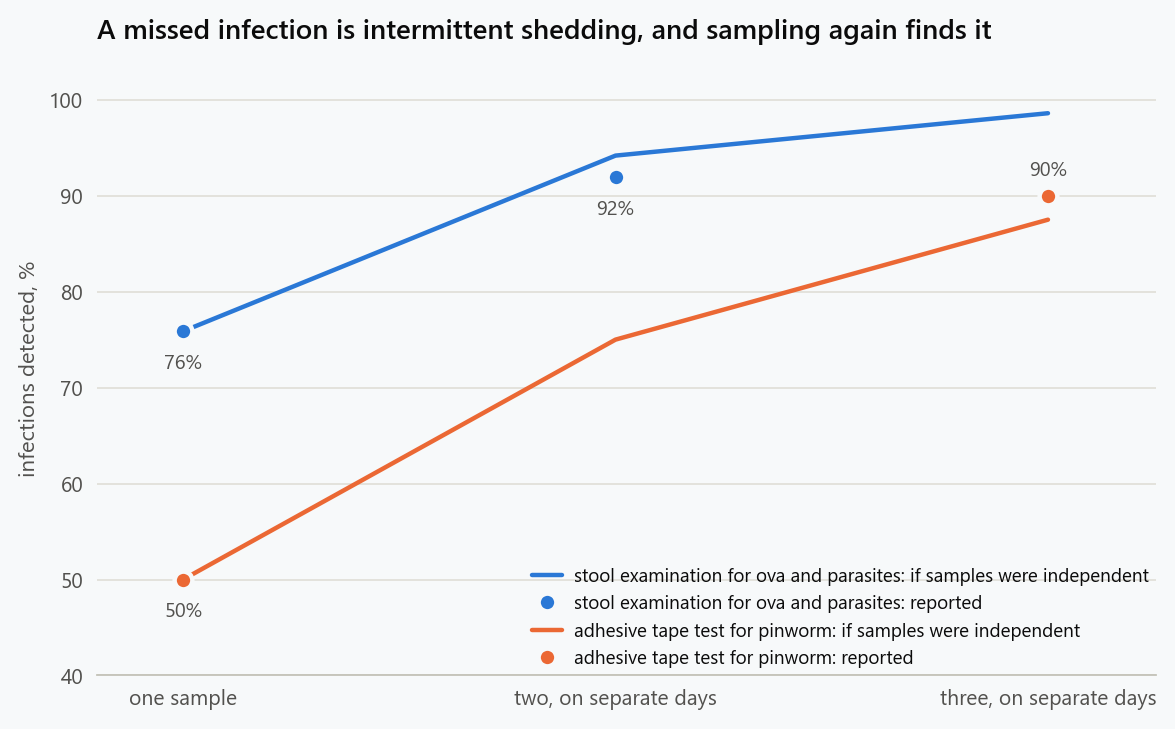
The reason for the misses is known. Cysts and eggs are shed intermittently, so a sample taken on a quiet day contains nothing to find. If the days were independent, a test that finds a share $s$ of infections once would find $1 - (1 - s)^n$ of them in $n$ attempts. For stool examination that predicts 94.2% with two specimens against the 92% observed, and for the tape test 87.5% over three mornings against the reported figure of about 90%. The agreement is close enough to say that the organism is not hiding from the test. It is absent from some samples and present in others, and the remedy is the one laboratories already use, which is to collect specimens on separate days.
What Negative Results Leave Behind
Imperfect sensitivity does not make a negative result meaningless. It makes it worth a calculable amount. With a sensitivity of 72% and few false positives, each negative examination divides the odds of infection by about 3.6. Branda and colleagues give the negative predictive value of one examination as roughly 98%, 97%, 95% and 93% when 5%, 10%, 15% and 20% of those tested are infected, and Bayes' rule with their sensitivity returns 98.5%, 97.0%, 95.3% and 93.5%.
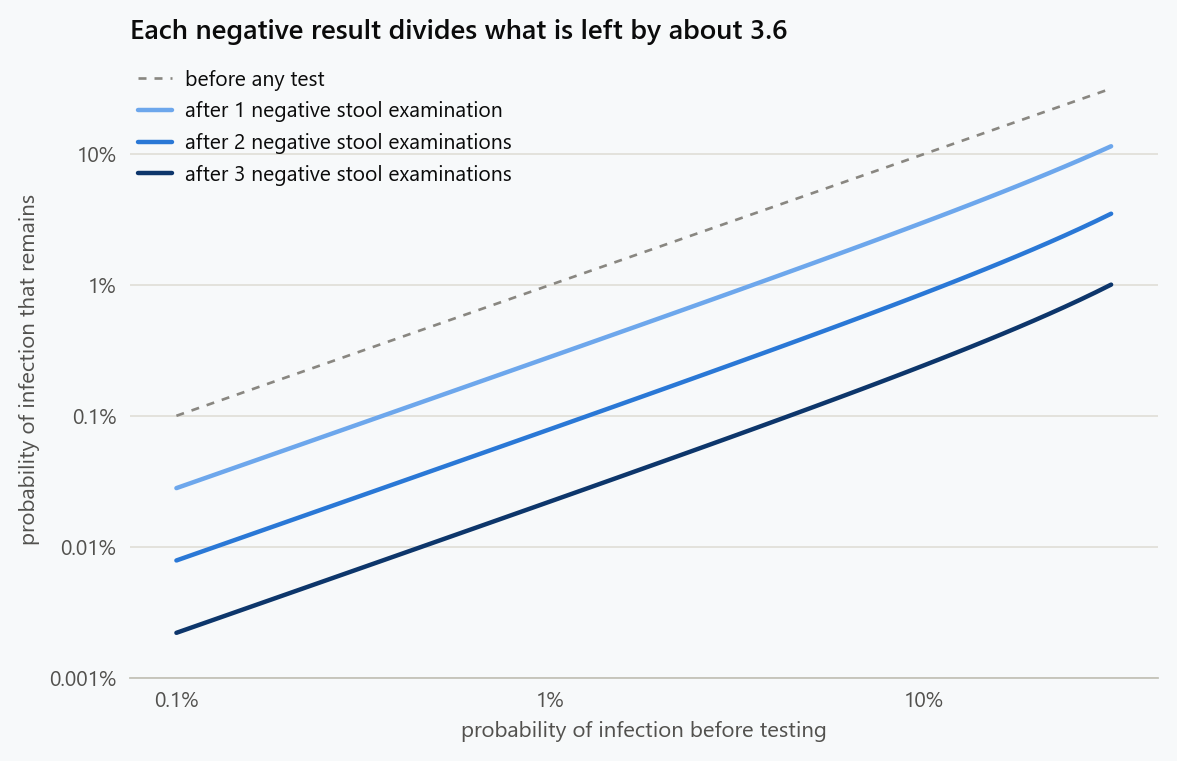
A person whose history justified a 5% suspicion is at 1.5% after one negative result and 0.12% after three. Someone who started at 1% is at 0.022% after three, about one in 4,500. The conclusion does not depend on trusting the published sensitivity. Halve it, to 50% per specimen, and three negative results still take 5% to 0.65% and 1% to 0.13%. Doubt about the test is a reason to repeat it, or to use an antigen or molecular test aimed at the organism in question, and it is never a reason to conclude that the infection is present.
The cleanse narrative handles evidence in the opposite way. A positive result confirms the parasite, and a negative one shows that the parasite evaded detection. The same structure governs the treatment. Improvement means the protocol is working, nausea and headache are a "die-off reaction" and also mean it is working, and no change means more is needed. There is a real inflammatory reaction to the killing of organisms, the Jarisch-Herxheimer reaction, and it is a specific phenomenon in the antibiotic treatment of spirochaetal infections such as syphilis (Butler, 2017), not a general property of herbs and worms. When every possible observation counts in favour of a claim, the observations have stopped being evidence for it. An adverse effect during an unproven treatment should be considered an adverse effect first.
What Appears During a Cleanse
Photographs of long, rope-like strands passed during a cleanse are the most persuasive material in this genre. They have a published history. In 2013 four authors posted a preprint describing a new human parasite, the "rope worm", and its five developmental stages (Volinsky et al., 2013). The specimens had been obtained by cleansing enemas, and the paper's own descriptions of the stages are of mucus: "viscous snot", "slimier mucus", "a tough string of mucus about a meter long". No such organism has been established by parasitologists. The ordinary explanation is that an irritated bowel sheds mucus, and that enemas and laxative herbs irritate it.
Material that looks like a worm can also be tissue. A 2026 case report describes an infant who passed rope-like material that first raised the suspicion of intestinal parasites; histology showed a cast of necrotic colonic lining from severe Clostridioides difficile colitis (Hosiian et al., 2026). The point of that case is the method. The material was identified under a microscope by a pathologist, and the answer mattered. Parasitology laboratories use morphology, antigen detection and molecular tests because stool is full of plant fibres, mucus and debris that resemble organisms, and the CDC's diagnostic reference pages include a gallery of such artefacts, in which plant hairs pass for larvae and pollen grains for worm eggs. A photograph is not an identification.
An Active Plant Is Not a Validated Treatment
Cleanse products usually combine wormwood, black walnut hull and clove, and the defence of them usually begins with artemisinin. The example is a good one and it cuts the other way. Artemisinin was isolated from Artemisia annua and became the basis of the most important class of antimalarial drugs. What cures malaria is a defined artemisinin derivative, at a controlled dose, combined with a partner drug to delay resistance, given after the species has been confirmed. The World Health Organization recommends those combination therapies and explicitly does not support Artemisia teas, tablets or capsules as treatment. The path from plant to medicine ran through isolation, dosing and trials, and the tea was left behind on the way.
The most dramatic recent claim for the tea shows why. A trial published in 2018 randomised 800 patients with schistosomiasis to the standard drug praziquantel or to infusions of A. annua or A. afra, and reported that every patient given the tea had no detectable eggs within 14 days (Munyangi et al., 2018). In 2020 the journal retracted the paper at the request of its editor-in-chief, citing concerns about the timing of ethical approval, about participants' consent, and about the reliability of the data, for which the authors could not provide reasonable explanations. A companion malaria trial by the same group was retracted as well. The retraction does not show that the plants are inert. It shows how little a spectacular result is worth before it has been scrutinised and repeated.
Real anthelmintic drugs, meanwhile, demonstrate how specific efficacy is. In a network meta-analysis of 55 randomised trials of single-dose treatment, albendazole cured 79.5% of hookworm infections, but the best available drug against whipworm, mebendazole, cured only 42.1%, and the cure rate of albendazole against whipworm fell from 38.6% in 1995 to 16.4% in 2015 (Moser et al., 2017). A licensed drug, at a known dose, cures four infections in five of one worm and one in six of another. Against that background, the claim that a single mixture of herbs clears "parasites" in general is not a modest claim awaiting confirmation. It contradicts what has been measured about how these organisms respond.
Herbal Does Not Mean Harmless
The ingredients are pharmacologically active, which is the premise of selling them, and active substances have toxic doses. Wormwood contains thujone, a convulsant. A risk assessment derived an acceptable daily intake of 0.11 mg per kilogram from seizure data in rats and estimated that it would be reached by somewhere between 2 and 20 cups of wormwood or sage tea, concluding that short-term use of the tea is safe (Lachenmeier & Uebelacker, 2010). The reassurance applies to tea. Essential oils and concentrated extracts are a different exposure, as clove shows: a 15-month-old boy who swallowed 10 ml of clove oil developed fulminant liver failure, with an alanine aminotransferase above 13,000 U/l (Janes et al., 2005). The NIH LiverTox database also records rare cases of liver injury from artemisinin taken as a herbal supplement over long periods.
The larger harm comes from the step after the herbs, when people who are convinced they are infected move on to antiparasitic drugs bought without a diagnosis. The best data on what that does come from the period when ivermectin was promoted for Covid-19, a different false indication with the same behaviour. Calls about ivermectin to the Oregon Poison Center rose from 0.25 a month in 2020 to 21 in August 2021. Of those 21 people, 17 had bought veterinary formulations, six were admitted to hospital and four needed intensive care (Temple et al., 2021). Over the following 24 weeks the same centre recorded 37 cases of ivermectin toxicity, of whom 21 were hospitalised, 30 had neurological effects and one died (Hoang et al., 2022).
None of this means that every cleanse poisons its user. The narrower point is sufficient: when the benefit of a treatment is unproven, there is nothing to set against even a small risk, and a delay in finding the real cause of persistent symptoms is a cost as well. Coeliac disease, inflammatory bowel disease and bowel cancer all produce the symptoms on the checklist.
Which Parasite?
The business model depends on vagueness at every point. The diagnosis is broad, the symptoms are common, the organism is unnamed, tests are dismissed in advance, side effects are reinterpreted as success, and the protocol can be repeated indefinitely. A clinical diagnosis becomes more precise as evidence accumulates, and this one stays useful only as long as it does not.
The remedy is to ask for the specifics, which turns a parasite cleanse back into parasitology. Which organism is suspected, and what exposure makes it plausible? Which symptoms are characteristic of it, as nocturnal itching is of pinworm, and which are merely common? Which test finds it, how sensitive is one sample, and how many have been taken? Which drug has been shown to clear that species, and how is cure confirmed? A suspicion that survives those questions deserves a laboratory, and the numbers above say what the laboratory's answer will be worth. One that cannot name its organism is not a diagnosis, and a protocol aimed at it is not a treatment.
References
- Branda, J. A., Lin, T. Y., Rosenberg, E. S., Halpern, E. F., & Ferraro, M. J. (2006). A rational approach to the stool ova and parasite examination. Clinical Infectious Diseases, 42(7), 972-978. https://doi.org/10.1086/500937
- Butler, T. (2017). The Jarisch-Herxheimer reaction after antibiotic treatment of spirochetal infections: a review of recent cases and our understanding of pathogenesis. American Journal of Tropical Medicine and Hygiene, 96(1), 46-52. https://pubmed.ncbi.nlm.nih.gov/28077740/
- Cartwright, C. P. (1999). Utility of multiple-stool-specimen ova and parasite examinations in a high-prevalence setting. Journal of Clinical Microbiology, 37(8), 2408-2411. https://doi.org/10.1128/JCM.37.8.2408-2411.1999
- Centers for Disease Control and Prevention. Diagnosis of parasitic diseases. https://www.cdc.gov/parasites/testing-diagnosis/index.html
- Centers for Disease Control and Prevention. DPDx: artifacts. https://www.cdc.gov/dpdx/artifacts/index.html
- Centers for Disease Control and Prevention. Giardiasis NNDSS summary report for 2022. https://www.cdc.gov/healthy-water-data/documentation/giardiasis-nndss-summary-report-for-2022.html
- Garcia, L. S., & Shimizu, R. Y. (1997). Evaluation of nine immunoassay kits (enzyme immunoassay and direct fluorescence) for detection of Giardia lamblia and Cryptosporidium parvum in human fecal specimens. Journal of Clinical Microbiology, 35(6), 1526-1529. https://doi.org/10.1128/jcm.35.6.1526-1529.1997
- Hoang, R., Temple, C., Correia, M. S., Clemons, J., & Hendrickson, R. G. (2022). Characteristics of ivermectin toxicity in patients taking veterinary and human formulations for the prevention and treatment of COVID-19. Clinical Toxicology, 60(12), 1350-1355. https://doi.org/10.1080/15563650.2022.2134788
- Hosiian, A., Hassan, M., Ghanem, A., Alafandi, M., Ghanem, H., & Alani, A. (2026). Expulsion of rope-like material per rectum in an infant: a rare case report of pseudomembranous colitis. Oxford Medical Case Reports, 2026(6), omag090. https://doi.org/10.1093/omcr/omag090
- Janes, S. E., Price, C. S., & Thomas, D. (2005). Essential oil poisoning: N-acetylcysteine for eugenol-induced hepatic failure and analysis of a national database. European Journal of Pediatrics, 164(8), 520-522. https://doi.org/10.1007/s00431-005-1692-1
- Lachenmeier, D. W., & Uebelacker, M. (2010). Risk assessment of thujone in foods and medicines containing sage and wormwood: evidence for a need of regulatory changes? Regulatory Toxicology and Pharmacology, 58(3), 437-443. https://doi.org/10.1016/j.yrtph.2010.08.012
- Lashaki, E. K., Mizani, A., Hosseini, S. A., Habibi, B., Taherkhani, K., Javadi, A., Taremiha, A., & Dodangeh, S. (2023). Global prevalence of enterobiasis in young children over the past 20 years: a systematic review and meta-analysis. Osong Public Health and Research Perspectives, 14(6), 441-450. https://doi.org/10.24171/j.phrp.2023.0204
- Moser, W., Schindler, C., & Keiser, J. (2017). Efficacy of recommended drugs against soil transmitted helminths: systematic review and network meta-analysis. BMJ, 358, j4307. https://doi.org/10.1136/bmj.j4307
- Munyangi, J., Cornet-Vernet, L., Idumbo, M., Lu, C., Lutgen, P., Perronne, C., Ngombe, N., Bianga, J., Mupenda, B., Lalukala, P., Mergeai, G., Mumba, D., Towler, M., & Weathers, P. (2018). Effect of Artemisia annua and Artemisia afra tea infusions on schistosomiasis in a large clinical trial. Phytomedicine, 51, 233-240. Retracted: Phytomedicine, 78, 153303 (2020). https://doi.org/10.1016/j.phymed.2020.153303
- National Institute of Diabetes and Digestive and Kidney Diseases. Artemisinin. LiverTox. https://www.ncbi.nlm.nih.gov/books/NBK548419/
- Temple, C., Hoang, R., & Hendrickson, R. G. (2021). Toxic effects from ivermectin use associated with prevention and treatment of Covid-19. New England Journal of Medicine, 385(23), 2197-2198. https://doi.org/10.1056/NEJMc2114907
- Volinsky, A. A., Gubarev, N. V., Orlovskaya, G. M., & Marchenko, E. V. (2013). Development stages of the "rope" human intestinal parasite. Preprint, arXiv:1301.2845. https://arxiv.org/abs/1301.2845
- Wendt, S., Trawinski, H., Schubert, S., Rodloff, A. C., Mössner, J., & Lübbert, C. (2019). The diagnosis and treatment of pinworm infection. Deutsches Ärzteblatt International, 116(13), 213-219. https://doi.org/10.3238/arztebl.2019.0213
- World Health Organization. Global Malaria Programme: treatment. https://www.who.int/teams/global-malaria-programme/case-management/treatment
- World Health Organization (2023). Soil-transmitted helminth infections: fact sheet. https://www.who.int/news-room/fact-sheets/detail/soil-transmitted-helminth-infections
This article discusses parasitology and the evidential limits of commercial parasite-cleansing claims. Persistent diarrhoea, unexplained weight loss, fever after travel, visible worms, suspected malaria or other signs of parasitic infection require organism-specific medical evaluation.
Embed interactive plots, widgets, and demos using <figure>, <iframe>, or <div class="interactive-embed"> containers. Ensure each embed includes descriptive captions for accessibility.
How to cite
Use the quick export buttons to save citations for reference managers or copy the formatted text directly.
Diogo Ribeiro (2026). Parasites Are Diagnosed by Species, Not by Symptom Lists. Faculty of Media Arts and Design, Technical University of Porto. https://diogoribeiro7.github.io/healthcare/parasite_cleanse_social_media_myth/.