Topics
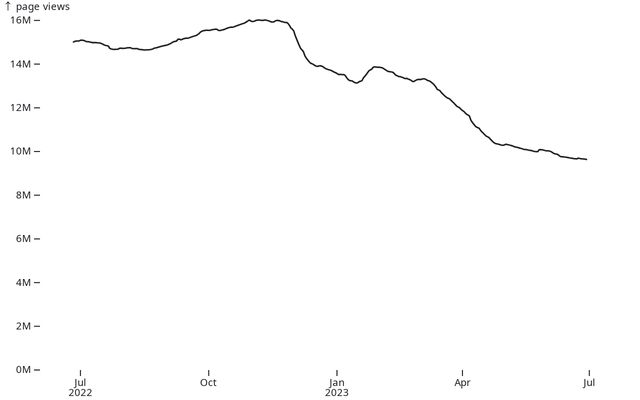
Decay of traffic in Stack Overflow
Large language models depend on living knowledge ecosystems. Public forums, documentation, code repositories, issue trackers, blogs, and Q&A sites capture the practical problem-solving work that formal publications often miss. When those ecosystems shrink, become inaccessible, or move behind restrictive terms, models lose more than text; they lose exposure to current practice.
The risk is not that one website disappears and model development stops. The risk is a slow reduction in data diversity, freshness, provenance, and public auditability. A model trained mostly on closed, synthetic, or stale data may remain fluent while becoming less grounded in the way practitioners actually solve problems.
This article examines why open technical communities matter to LLMs, what alternatives exist, and what a healthier data strategy would look like.
The Role of Open-Source Data in Training LLMs
Open technical platforms provide several forms of signal that are difficult to manufacture:
- Problem context: questions reveal what users tried, what failed, and where documentation was ambiguous.
- Multiple solution paths: accepted answers, comments, and competing responses show trade-offs rather than only final code.
- Temporal freshness: new framework versions, API changes, and operational patterns appear in public discussion before they appear in textbooks.
- Quality signals: votes, maintainers, issue resolution, and citations help separate useful answers from weak ones.
- Natural language grounding: users describe errors and goals in messy, realistic language.
This data is valuable because it is social and iterative. It captures human correction, disagreement, and maintenance over time. Removing that flow weakens the connection between model training data and real practice.
Alternative Data Sources
Several alternatives can complement open platforms, but none is a complete substitute.
| Source | Strength | Limitation |
|---|---|---|
| Academic papers | rigor, citations, formal methods | slower, less operational, less conversational |
| Official documentation | authoritative API behavior | often lacks failure cases and migration pain |
| Proprietary support logs | realistic production problems | closed, biased toward one company or product |
| Synthetic data | scalable and controllable | can amplify model blind spots and stale assumptions |
| Licensed expert corpora | clearer rights and provenance | expensive and narrower in coverage |
A resilient training strategy should combine licensed public data, high-quality documentation, domain expert review, retrieval systems, and evaluation sets that test current factual and procedural knowledge.
What Happens if Open-Source Platforms Close?
If open platforms become smaller or less accessible, several failure modes become more likely:
- Staleness: models answer with old library patterns, deprecated APIs, or abandoned best practices.
- Reduced coverage: niche languages, regional practices, and long-tail troubleshooting cases disappear first.
- Less verifiability: users cannot easily trace claims back to public discussions or source material.
- Feedback concentration: a few large data owners gain disproportionate influence over what models learn.
- Synthetic feedback loops: models trained on model-generated data risk converging toward plausible but brittle explanations.
The result would not be immediate collapse. It would be gradual erosion: fluent systems that are less connected to current, diverse, human-validated knowledge.
The Indispensable Role of the Human Element
Human contribution remains central because LLMs do not independently decide what matters, what changed, or which answer is responsible in a specific context. Humans provide the corrective pressure:
- maintainers update documentation and migration guides;
- practitioners report bugs and edge cases;
- reviewers challenge incomplete answers;
- educators turn tacit knowledge into reusable explanations;
- domain experts define what counts as a harmful or unacceptable answer.
The long-term health of LLMs therefore depends on healthier incentives for public knowledge production. Attribution, licensing, moderation, archiving, and compensation are not side issues; they shape whether people continue creating the data that makes models useful.
The Co-Dependence of Man and Machine
The relationship between people and models should be treated as a knowledge supply chain. If the public layers of that supply chain decay, models become more dependent on closed data, synthetic data, and retrieval systems controlled by a smaller set of actors.
The better path is not to extract public knowledge until communities fail. It is to build data practices that keep those communities healthy:
- license and attribute public datasets clearly;
- support archival copies of high-value technical knowledge;
- use retrieval to cite current sources rather than relying only on frozen training data;
- maintain evaluation sets for recent APIs, tools, and domain changes;
- invest in human expert review for high-risk domains.
LLMs are strongest when they are connected to active human knowledge systems. Protecting those systems is not nostalgia for the old web; it is infrastructure work for reliable machine learning.
References
- Bommasani, R., et al. (2021). On the opportunities and risks of foundation models. Stanford CRFM.
- Bender, E. M., Gebru, T., McMillan-Major, A., & Shmitchell, S. (2021). On the dangers of stochastic parrots. FAccT '21.
- Dodge, J., et al. (2021). Documenting large webtext corpora: A case study on the Colossal Clean Crawled Corpus. EMNLP.
- Mitchell, M., et al. (2019). Model cards for model reporting. FAccT '19.
Embed interactive plots, widgets, and demos using <figure>, <iframe>, or <div class="interactive-embed"> containers. Ensure each embed includes descriptive captions for accessibility.
How to cite
Use the quick export buttons to save citations for reference managers or copy the formatted text directly.
Diogo Ribeiro (2023). The Vulnerability of Large Language Models to the Closure of Open-Source Data Platforms. Faculty of Media Arts and Design, Technical University of Porto. https://diogoribeiro7.github.io/machine-learning/large_languague_models/.