Topics
Machine learning models are trained on historical data and deployed into environments that keep changing. Customers change behavior. Sensors age. Fraud patterns adapt. Clinical workflows evolve. Supply chains shift. Data pipelines are refactored. Regulations change. Competitors react. A model that was valid at training time can become unreliable months, weeks, or even days after release.
This is drift.
Drift is not one problem. It is a family of production failures caused by changes in data, labels, relationships, decisions, or measurement systems. Some drift is harmless. Some drift destroys calibration while leaving ranking metrics stable. Some drift affects only a subgroup. Some drift is caused by the model itself.
The practical goal is not to raise alerts every time a distribution changes. The goal is to know when a deployed model is no longer trustworthy for the decisions it supports.
Drift Is a Production Reliability Problem
It is tempting to treat drift as a statistical test: compare training data with production data, compute a p-value, and alert when the distributions differ. That is useful, but incomplete.
A production model is part of a decision system. Drift matters when it changes predictions, probabilities, thresholds, workloads, interventions, fairness, or business outcomes.
For example, a change in the distribution of a rarely used feature may be statistically significant but operationally irrelevant. A small change in disease prevalence may be hard to detect early but can severely damage positive predictive value in a screening model. A new sensor firmware version may preserve feature means while changing missingness patterns and edge cases. A recommender system may alter user behavior, then train on behavior it helped create.
Good drift monitoring therefore asks three questions:
- What changed?
- Does the change affect model behavior or decision value?
- What response is justified?
The answer depends on the type of drift.
Feature Drift
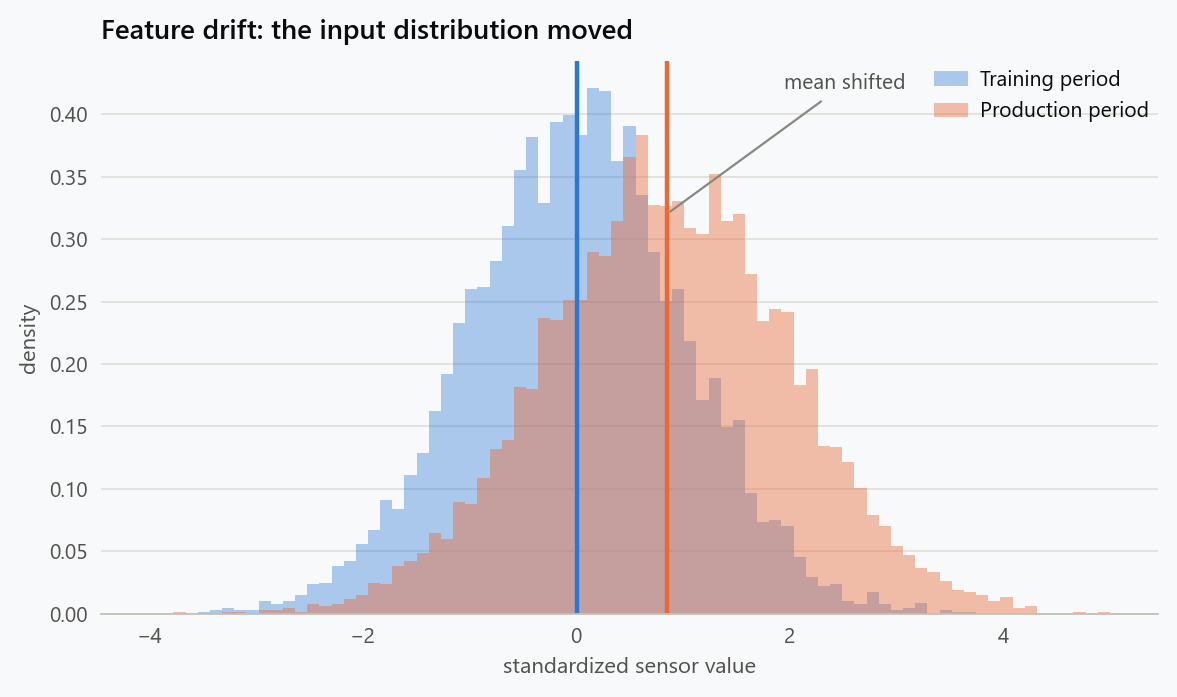
Feature drift occurs when the distribution of input variables changes:
Examples:
- A hospital starts admitting older patients after a policy change.
- A machine sensor is recalibrated and vibration values shift upward.
- A fraud model sees a new device type after a mobile app release.
- A churn model receives customers from a new acquisition channel.
- A demand model sees different order volumes after a promotion.
Feature drift is often the easiest drift to detect because it does not require labels. We can monitor production inputs as soon as they arrive.
Useful signals include:
- Mean, median, variance, quantiles, and missingness rates
- Population stability index
- Kolmogorov-Smirnov tests for continuous variables
- Chi-square tests for categorical variables
- Jensen-Shannon divergence
- Wasserstein distance
- Embedding-distance changes for text, images, or high-dimensional records
- New categories and schema violations
Feature drift does not automatically mean the model is wrong. If the shifted feature has little predictive importance, the model may remain stable. If the shift occurs near a decision threshold, the same change may be critical.
Monitor feature drift, but diagnose its effect before retraining blindly.
Label Drift
Label drift, also called prevalence shift or base-rate drift, occurs when the distribution of the target changes:
Examples:
- Readmission rates fall after a hospital launches better discharge support.
- Equipment failures decline after preventive maintenance improves.
- Fraud prevalence rises during an attack.
- Churn increases after a price change.
- A rare disease becomes more common during an outbreak.
Label drift can be subtle because labels often arrive late. A fraud label may require investigation. A maintenance failure may be confirmed after inspection. A healthcare outcome may require 30 or 90 days of follow-up.
Label drift affects decision metrics strongly. Precision, alert yield, expected intervention value, and workload all depend on the base rate.
For example, a maintenance alert model may keep the same recall and false positive rate. If true failure prevalence falls from 10 percent to 1 percent, the inspection queue can become dominated by false positives. The model ranking may still be useful, but the threshold may no longer be appropriate.
Monitor label drift with:
- Mature outcome prevalence by period
- Observed-to-expected ratios
- Precision and recall after labels mature
- Random audits when labels are only observed for reviewed cases
- Calibration curves by time period
- Base rates by subgroup, site, product, or device
If label drift is the main problem, threshold adjustment or recalibration may be enough. If the feature-label relationship also changed, retraining may be needed.
Concept Drift
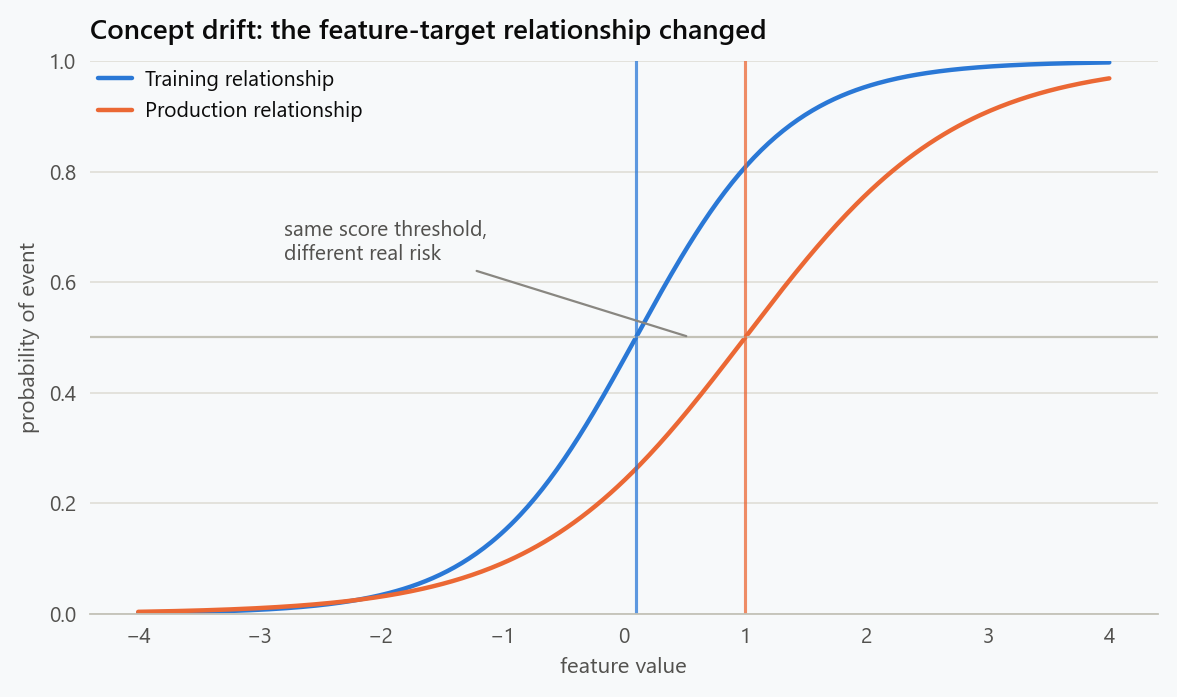
Concept drift occurs when the relationship between inputs and the target changes:
This is often the most important form of drift because the model's learned mapping is no longer valid.
Examples:
- A lab value has different meaning after a treatment protocol changes.
- A fraud feature stops working because attackers adapt.
- A vibration pattern that used to indicate bearing wear now reflects a new operating mode.
- A customer tenure feature loses predictive value after subscription terms change.
- A recommender model trained on old user behavior fails after the product interface changes.
Concept drift usually requires labels to confirm because we need to know whether prediction errors changed. Proxy signals can help, but true diagnosis needs outcomes.
Monitor concept drift through:
- Performance metrics by time period
- Calibration by time period
- Error rates by slice
- Residual trends for regression models
- Feature attribution changes
- Threshold performance and alert yield
- Case review of high-confidence errors
Concept drift often requires model retraining, feature redesign, or even target redesign. Recalibration alone may not fix it.
Prediction Drift
Prediction drift occurs when the distribution of model outputs changes:
or, for probabilistic models:
Prediction drift is useful because predictions are always available, even when labels are delayed. It is also directly connected to operations. If a fraud model suddenly flags twice as many transactions, the review team feels that immediately. If a maintenance model suddenly moves many assets above an inspection threshold, the work-order queue changes.
Prediction drift can be caused by feature drift, code changes, schema changes, upstream data issues, or real changes in the population.
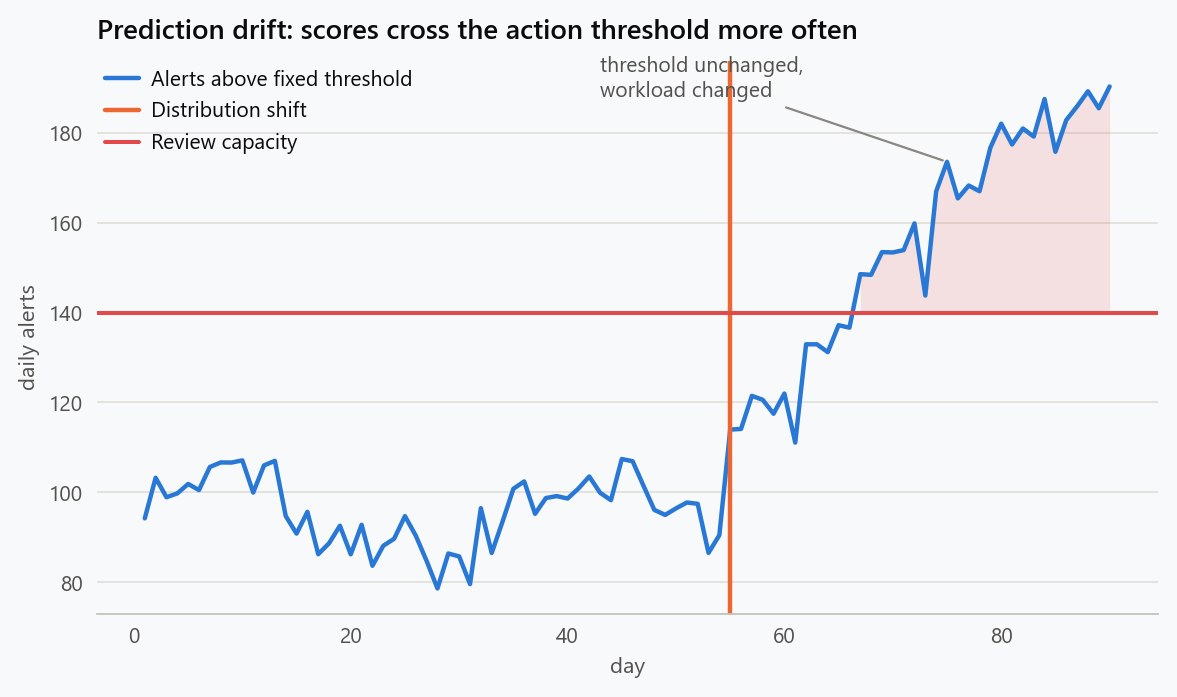
Monitor:
- Score distributions
- Fraction of cases above thresholds
- Alert volume
- Prediction entropy or uncertainty
- Average predicted risk
- Distribution of predicted classes
- Changes by subgroup, site, channel, or device
Prediction drift is an early-warning signal. It does not tell us the root cause by itself.
Reality Drift
Reality drift is a broad external change that makes the training environment no longer representative.
Examples:
- A pandemic changes healthcare demand, mobility, and clinical workflows.
- A supply-chain disruption changes delivery times and demand patterns.
- A new regulation changes lending, insurance, or employment decisions.
- A factory introduces a new operating regime or equipment generation.
- A macroeconomic shock changes customer behavior.
Reality drift can combine feature drift, label drift, and concept drift. It often breaks assumptions across multiple systems at once.
The right response may be more than retraining. Teams may need temporary rules, model suspension, human review, new data collection, new features, changed thresholds, or a new target definition.
Feedback Drift and the Law of Diminishing Returns
Feedback drift occurs when model decisions affect the future data used to train or evaluate the model.
Examples:
- A churn model offers discounts to high-risk customers, changing future churn labels.
- A fraud model blocks suspicious transactions, so only unblocked transactions receive full outcome observation.
- A recommender system changes what users click by changing what users see.
- A predictive maintenance model triggers inspections, preventing failures that would have become labels.
- A clinical model changes treatment, which changes patient outcomes.
Feedback drift is dangerous because the model changes the world it later observes. The observed label is no longer a passive measurement of risk. It is partly a consequence of the intervention.
Mitigation strategies include:
- Randomized holdout or exploration policies
- Logging treatment and intervention decisions
- Separating prediction from action in evaluation data
- Using causal evaluation where interventions change outcomes
- Auditing cases outside model-selected workflows
- Tracking counterfactual uncertainty
Feedback drift is not solved by retraining alone. Retraining on intervention-shaped data can amplify the feedback loop.
Drift Is Not Always Bad
Some drift is expected and even desirable.
If a maintenance program reduces failures, the label distribution should change. If a fraud system blocks an attack, the observed fraud mix should change. If a hospital improves care transitions, readmissions should decline. If a recommender improves engagement, user behavior may shift.
The monitoring question is not "did anything change?" The better question is:
Did the change make the current model, threshold, or decision policy unreliable?
This distinction prevents alert fatigue. Drift monitoring should prioritize actionability.
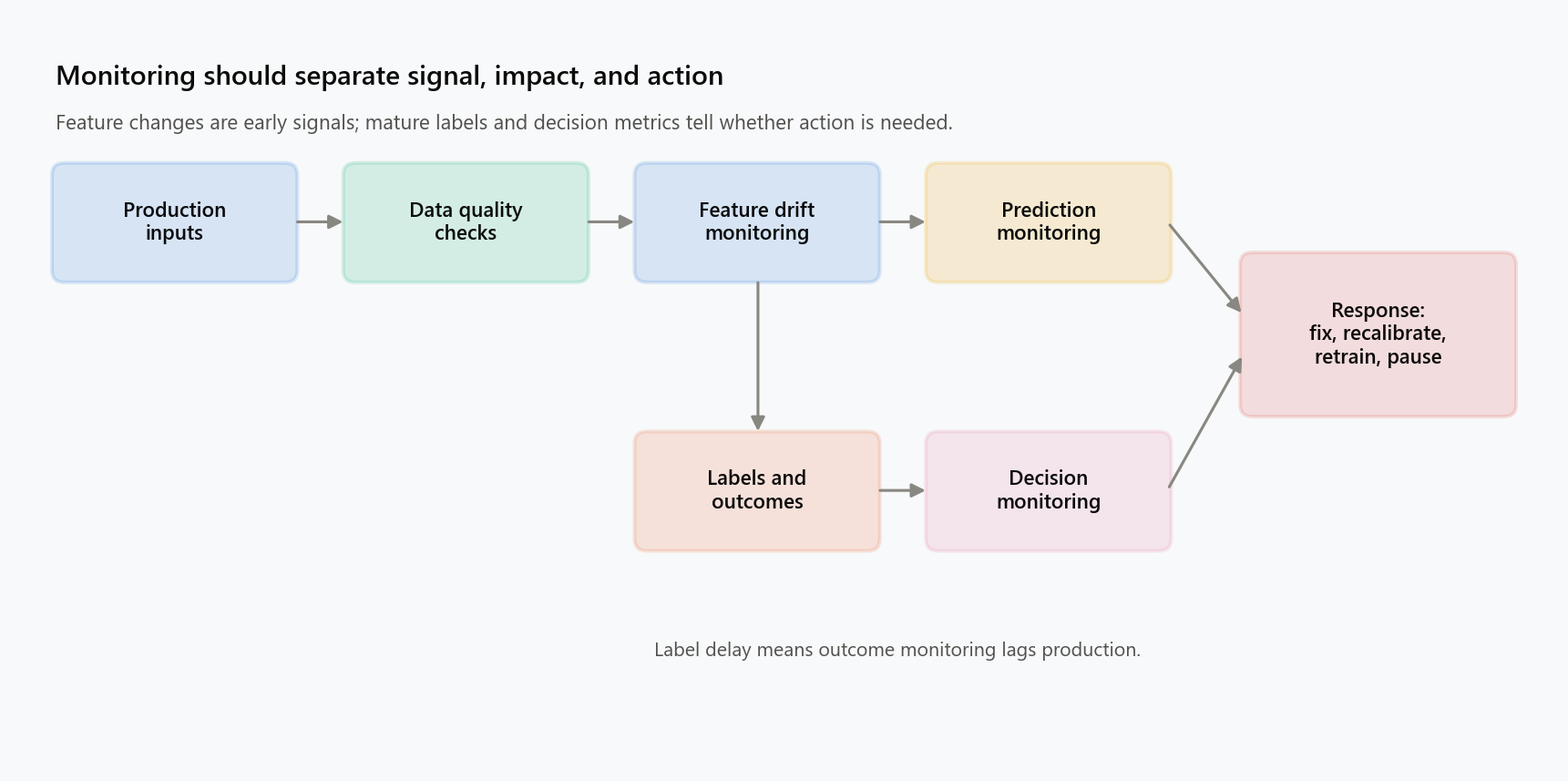
A Practical Drift Monitoring Design
A useful drift monitoring system has several layers.
1. Data Quality Checks
These checks catch broken inputs before statistical drift tests.
Monitor:
- Schema changes
- Missing required fields
- New categories
- Invalid ranges
- Units and scale changes
- Duplicate records
- Timestamp anomalies
- Join failures
- Feature freshness
Many apparent drift problems are actually data pipeline problems.
2. Feature Distribution Monitoring
Track important input distributions over time. Prioritize features that are predictive, decision-relevant, or operationally fragile.
Avoid monitoring hundreds of features with equal urgency. That creates alert noise.
3. Prediction Monitoring
Track the output distribution and threshold consequences.
Monitor:
- Average score
- Score quantiles
- Alert count
- Action count
- Review workload
- Abstention rate
- Prediction class distribution
This layer is often the fastest way to detect operational impact.
4. Label and Outcome Monitoring
When labels mature, compare predicted and observed outcomes.
Monitor:
- AUC, PR AUC, recall, precision, and specificity
- Calibration
- Brier score
- Residuals
- Outcome prevalence
- Error by slice
- Performance by time since deployment
Label delay should be explicit. Do not evaluate recent predictions before outcomes are observable.
5. Decision Monitoring
A model is useful only if the decisions remain useful.
Monitor:
- Cost per true positive
- Net benefit
- Intervention yield
- Queue delay
- Manual review overrides
- False positive burden
- Missed-event cost
- Subgroup impact
This is the layer that connects drift to business or clinical value.
Diagnosing a Drift Alert
When a drift alert fires, do not start with retraining. Start with diagnosis.
Ask:
- Did the data pipeline change?
- Did the schema, unit, or encoding change?
- Which features shifted?
- Did model scores shift?
- Did threshold workload change?
- Did labels mature enough to evaluate performance?
- Did outcome prevalence change?
- Is the issue global or isolated to a slice?
- Did an intervention, policy, or external event explain the change?
- Is the model wrong, or is the decision threshold outdated?
This sequence avoids costly mistakes. Retraining a model on corrupted data can make the problem worse. Adjusting a threshold when the pipeline is broken can hide the real issue. Ignoring subgroup drift can preserve average performance while harming a specific population.
Response Strategies
The response should match the diagnosis.
If the problem is a pipeline issue, fix the pipeline and backfill affected features.
If the problem is feature drift without performance loss, keep monitoring and consider stress testing.
If the problem is label drift with stable class-conditional behavior, recalibrate probabilities or adjust thresholds.
If the problem is concept drift, retrain with recent representative data, redesign features, or update the target.
If the problem is a new segment, collect labels and evaluate whether a segment-specific model or rule is needed.
If the problem is feedback drift, redesign evaluation with randomized audits, causal analysis, or explicit intervention logging.
If the problem is severe reality drift, consider pausing automation or routing more cases to human review until a new model can be validated.
Drift response is an engineering and governance process, not just a modeling task.
Examples
Healthcare
A readmission model trained on historical discharges may degrade after a hospital launches a virtual follow-up program. Readmission prevalence falls, but the model still outputs risks calibrated to the old environment. The best immediate response may be recalibration and threshold review, not full retraining.
If clinical workflows change and the same features no longer mean the same thing, concept drift is more likely. For example, a lab test ordered only for severe cases in the past may become routine screening. The feature's relationship with outcome changes.
Predictive Maintenance
A failure model may show prediction drift after new sensor firmware changes vibration scaling. That is a data quality or feature drift issue. Retraining without correcting the unit change would be wrong.
A preventive maintenance campaign may reduce true failure prevalence. The model may still rank assets well, but the inspection threshold may generate low-yield work orders. That is a decision-policy problem.
Fraud
Fraud patterns change because attackers adapt. Feature drift, label drift, and concept drift can occur together. Review labels are also selected by the model, creating feedback. Fraud systems need random audits, fast label feedback, and threshold monitoring tied to analyst capacity.
Recommendation Systems
Recommenders are feedback systems by design. They affect what users see, which affects what users click, which affects future training data. Offline validation on passively observed logs can be misleading unless exposure and intervention effects are considered.
Common Mistakes
The first mistake is treating every distribution change as model failure.
The second mistake is monitoring only features and ignoring predictions, outcomes, thresholds, and decisions.
The third mistake is using labels before they mature.
The fourth mistake is retraining automatically without diagnosing the cause.
The fifth mistake is ignoring subgroup drift because global metrics look stable.
The sixth mistake is assuming AUC stability means the model is still useful. Calibration, precision, workload, and net benefit can change while AUC remains similar.
The seventh mistake is forgetting feedback loops. Models that change behavior also change future data.
Conclusion
Drift is one of the central problems of production machine learning. It appears when inputs change, labels shift, relationships evolve, predictions move, external reality changes, or model decisions reshape future data.
The solution is not a single drift detector. Reliable systems combine data quality checks, feature monitoring, prediction monitoring, delayed outcome evaluation, slice analysis, calibration tracking, and decision-level metrics.
Most importantly, drift monitoring must lead to diagnosis. The right response may be fixing a pipeline, adjusting a threshold, recalibrating probabilities, collecting labels, retraining, redesigning features, adding human review, or pausing automation.
Machine learning models do not fail only because algorithms are weak. They fail because the world moves. Drift monitoring is how production systems notice that movement before bad decisions accumulate.
The figure generator in the blog-reproducibility repository reproduces this article's figures; run it with --dry-run to print the numbers behind the figures without writing an image.
References
- Bayram, F., Ahmed, B. S., & Kassler, A. (2022). From concept drift to model degradation: An overview on performance-aware drift detectors.
- Ackerman, S., Raz, O., Zalmanovici, M., & Zlotnick, A. (2019). Automatically detecting data drift in machine learning classifiers.
- Gama, J., Zliobaite, I., Bifet, A., Pechenizkiy, M., & Bouchachia, A. (2014). A survey on concept drift adaptation. ACM Computing Surveys, 46(4).
- Lu, J., Liu, A., Dong, F., Gu, F., Gama, J., & Zhang, G. (2019). Learning under concept drift: A review. IEEE Transactions on Knowledge and Data Engineering, 31(12), 2346-2363.
- MLflow documentation: model tracking, evaluation, and lifecycle management for production machine learning systems.
Embed interactive plots, widgets, and demos using <figure>, <iframe>, or <div class="interactive-embed"> containers. Ensure each embed includes descriptive captions for accessibility.
How to cite
Use the quick export buttons to save citations for reference managers or copy the formatted text directly.
Diogo Ribeiro (2024). Understanding Drift in Machine Learning: Detection, Diagnosis, and Response. Faculty of Media Arts and Design, Technical University of Porto. https://diogoribeiro7.github.io/machine-learning/Drift/.