Topics
Few health phrases are as visually effective as leaky gut. The metaphor suggests a damaged barrier through which unwanted material enters the bloodstream and produces symptoms everywhere else, and it is flexible enough to explain almost anything: fatigue, bloating, acne, anxiety, autoimmune disease, brain fog, joint pain and weight gain. The difficulty for anyone who wants to dismiss it is that the underlying physiology is real. The intestine is a selectively permeable barrier, its permeability can be measured, and it rises in defined diseases and under defined stresses.
What does not follow is a single syndrome that accounts for every symptom attributed to it online. Between the physiology and the syndrome lie four separate claims: that permeability can be measured in the person concerned, that the measurement is abnormal, that the abnormality causes the symptoms, and that the proposed treatment repairs it and thereby relieves them. Each has been tested, and the results are more specific than either the marketing or a blanket dismissal would suggest.
A Barrier That Is Meant to Leak
A healthy intestine is not sealed. A barrier that blocked all movement would block the absorption of water and nutrients as well, so the physiological task is selective transport combined with defence. The barrier consists of surface mucus, a single layer of epithelial cells joined by tight junctions, and the immune system beneath them, and material crosses it between cells, through cells and wherever cells are shed (Camilleri, 2019). Its permeability changes with the segment of gut, the state of the immune system, the microbiota, diet, drugs and blood flow. Describing it as open or closed misrepresents a system whose normal condition is regulated passage.
Camilleri's review, written for clinicians, lists the stresses known to raise permeability in people without intestinal disease: endurance exercise, non-steroidal anti-inflammatory drugs, pregnancy, and surfactants such as bile acids and dietary emulsifiers. Its conclusion about the public conversation is direct. Information on healthy or leaky gut in the public domain, it says, requires confirmation before anyone endorses dietary exclusions or supplements to repair the damage.
Where Permeability Is Truly Abnormal
Coeliac disease is the clearest case of a barrier that fails. In eight patients studied before and after starting a gluten-free diet, intestinal permeability measured with sugar probes was ten times normal on a diet containing gluten, a ratio of 0.72, and fell to 0.17 after four weeks and 0.07 after eight, although two of the eight responded poorly (Cummins et al., 1991). Inflammatory bowel disease also involves barrier dysfunction, epithelial injury and immune activation, and barrier healing is being studied there as a predictor of how the disease will behave (Rath et al., 2023). These are conditions with diagnostic criteria, a known trigger or a defined pathology, and treatment that can be shown to work.
Healthy people raise their permeability as well, temporarily. A meta-analysis of 34 studies of a single bout of exercise found a standardised increase of 0.81 in a blood marker of intestinal cell damage and of 0.70 in sugar-probe permeability, with a larger effect on the damage marker in the heat, 1.06 against 0.66 in temperate conditions (Chantler et al., 2021). Nobody concludes that running causes a chronic syndrome. A stressor alters the barrier and it recovers, which is the behaviour of a regulated system and the opposite of the picture of a gut that, once leaky, stays so until a protocol repairs it.
Gluten shows how evidence gets transported between populations. In coeliac disease gluten is a defined trigger and removing it is the treatment. That says nothing about what gluten does to the barrier of someone without the disease, and wheat allergy and non-coeliac wheat sensitivity are separate clinical questions again. The chain from "gluten raises zonulin" to "gluten causes leaky gut and systemic disease in everyone" applies a mechanism established in a susceptible group to people in whom it has not been shown.
A Blood Test That Measures Something Else
The commercial diagnosis usually rests on serum zonulin. Zonulin was proposed as a regulator of tight junctions and identified as pre-haptoglobin 2, which made it an attractive candidate for a convenient blood marker of permeability. The kits sold to measure it have been examined three times, and they do not appear to measure it.
In 376 adults, results from a widely used commercial ELISA did not follow haptoglobin genotype as a test for pre-haptoglobin 2 would have to. When the investigators used mass spectrometry to identify what the kit's antibody captured, none of the proteins was pre-haptoglobin 2, and the kit did not detect recombinant pre-haptoglobin 2 at any concentration tried; the most likely target was properdin (Scheffler et al., 2018). A second group examined kits from two manufacturers and found that the top matches for the captured antigen were haptoglobin and complement C3 for one and complement C3 for the other, and advised caution in treating serum zonulin as a marker of barrier integrity (Ajamian et al., 2019). The number on the laboratory report is precise, and what it is a number of is unknown.
The third study asked the practical question of whether the result tracks permeability anyway. In 39 healthy relatives of patients with Crohn's disease, the serum marker from a commercial kit was compared with the lactulose-mannitol ratio, the standard sugar-probe measurement, and the correlation was $r^2 = 0.004$ (Power et al., 2021). The test explains 0.4% of the variation in measured permeability.
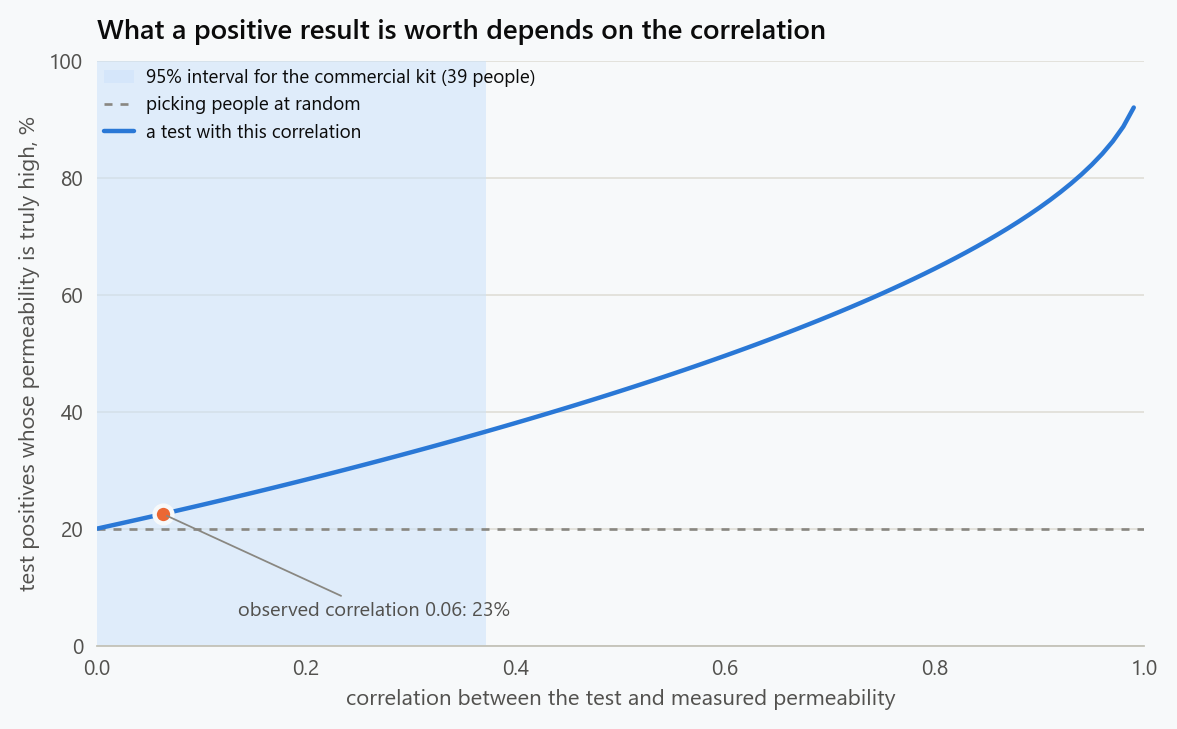
The figure turns that correlation into what a customer wants to know. Call a result positive when it falls in the highest fifth, and call a gut leaky when its measured permeability is in the highest fifth. If the two are jointly normal with correlation $r$, the share of positives who are truly leaky can be computed exactly. At the observed correlation of 0.063 it is 22.5%, against the 20% obtained by picking people at random. Thirty-nine people is a small study, and Fisher's transformation gives a 95% interval for the correlation from -0.26 to 0.37, so the data cannot exclude a modest relationship. Even at the top of that interval a positive result would be right 36.6% of the time. A test would need a correlation near 0.9 before three positives in four were correct.
What a Real Permeability Test Predicts
The sugar-probe test is a genuine measurement, affected by transit time, kidney function, urine collection and timing, which is why it remains mostly a research tool. The strongest evidence that it predicts anything comes from a cohort of 1,420 healthy first-degree relatives of patients with Crohn's disease, tested once and followed for a median of 7.8 years. Fifty developed the disease. An abnormal ratio at recruitment was associated with a hazard ratio of 3.03, with a 95% interval from 1.64 to 5.63, and the association persisted, at 1.62, when the test had been done more than three years before diagnosis (Turpin et al., 2020).
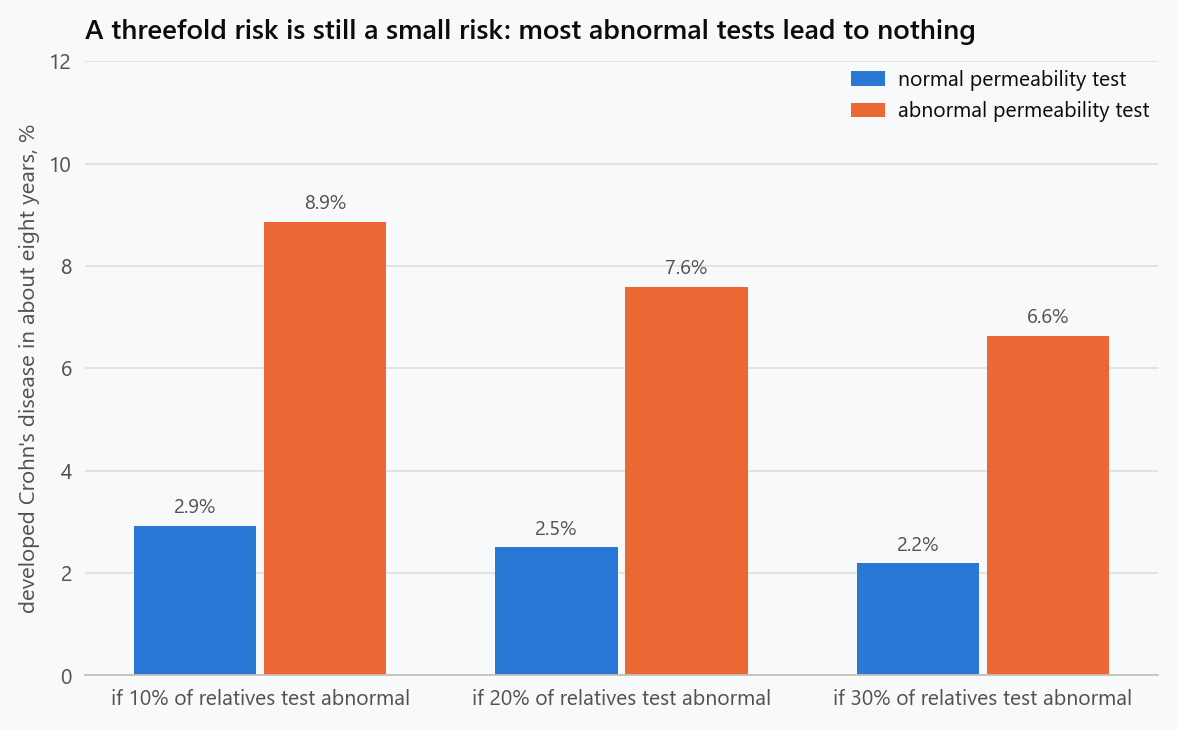
That is an important result for understanding how Crohn's disease begins, and it is worth translating into absolute terms before applying it to anyone. The overall risk in the cohort was 50 in 1,420, or 3.5%. The abstract does not give the share of relatives with an abnormal test, so the figure shows three possibilities, treating the hazard ratio as a ratio of risks, which is a fair approximation for an outcome this uncommon. If a fifth of relatives tested abnormal, the risk was 2.5% after a normal test and 7.6% after an abnormal one. In the group at highest known risk, with a validated test, more than nine abnormal results in ten were followed by no disease within eight years.
Those relatives carry a risk of Crohn's disease well above that of the general population, which is why they were studied. For someone with no family history and common symptoms, the prior probability is far lower, the test on offer is usually the zonulin kit and not the sugar probe, and the outcome being predicted is not Crohn's disease but a syndrome with no agreed definition. Each of those substitutions weakens the inference, and they are made together.
Repairing the Barrier
Glutamine is the supplement most often recommended to heal the gut, because intestinal cells use it as fuel. One randomised trial is striking. In adults who had developed diarrhoea-predominant irritable bowel syndrome after an intestinal infection and who had documented high permeability, 43 of 54 who took 15 g of glutamine a day for eight weeks met the primary endpoint, 79.6%, against 3 of 52 on placebo, 5.8%, and the lactulose-mannitol ratio at eight weeks was 0.05 against 0.11 on placebo (Zhou et al., 2019). The authors call for large trials to confirm it. Set beside it a meta-analysis of ten randomised trials across various conditions, in which glutamine had no overall effect on permeability, a weighted mean difference of -0.00 with a 95% interval from -0.04 to 0.03, with a possible effect only in a subgroup given more than 30 g a day (Abbasi et al., 2024). One positive trial in a narrowly selected group, unreplicated, is a reason for another trial. It is not evidence that glutamine repairs the gut of someone who has never had their permeability measured.
Probiotics illustrate a different problem. A meta-analysis of 26 randomised trials with 1,891 participants reports that probiotics improved barrier function, and one of its main outcomes is serum zonulin, which fell by a standardised 1.58 (Zheng et al., 2023). That outcome was measured with the kits described above, so the finding is that probiotics lower the blood level of an unidentified protein. A systematic review restricted to healthy people found 12 eligible studies out of 3,725 screened, moderate evidence that chicory inulin and probiotics lower permeability, very weak evidence that fructose raises it, and concluded that there was no strong evidence that diet raises or lowers permeability in healthy individuals (Nascimento et al., 2024).
The most direct test of the central idea came from pharmacology. Larazotide acetate was designed to block zonulin and tighten the barrier in coeliac disease. Across four randomised trials with 626 patients, it did not change the lactulose-mannitol ratio, whether patients were being challenged with gluten or not, and improved symptoms only during gluten challenge (Hoilat et al., 2022). The phase 3 trial that followed enrolled 307 patients and is recorded in the trials registry as terminated by its sponsor. A drug built to do exactly what gut-healing supplements claim to do, tested in the disease where permeability is least in doubt, did not measurably change permeability.
| Intervention | Evidence | Effect on measured permeability |
|---|---|---|
| Glutamine, in selected patients | One trial, 106 completed | Ratio of 0.05 against 0.11 on placebo |
| Glutamine, in all settings | Meta-analysis of ten trials | -0.00, interval -0.04 to 0.03 |
| Probiotics | Meta-analysis of 26 trials | Reported as serum zonulin, which the kits do not measure |
| Diet, in healthy people | Systematic review of 12 studies | No strong evidence in either direction |
| Larazotide, in coeliac disease | Meta-analysis of four trials, 626 patients | No difference from placebo |
A Marker Is Not the Disease
Suppose that permeability is genuinely raised in a person with symptoms. Several causal structures remain. The barrier defect may contribute to the illness, the illness may damage the barrier, a third factor such as inflammation or a drug may produce both, or each may feed the other. The Crohn's cohort matters because the abnormal test came years before the disease, which argues against the second explanation in that setting, and no comparable evidence exists for fatigue, acne or brain fog. Differences in the microbiome add another plausible layer without settling direction, since disease, diet and medication all change the microbiome too.
It follows that normalising a marker is not the same as treating a disease. The question for any intervention is whether symptoms, disease activity, complications or quality of life improve, and a change in a laboratory value is relevant only in so far as it predicts those. The commercial model avoids the question by construction. Its symptoms are non-specific, its biomarker is unvalidated, its endpoints are vague, and a lack of response can always be explained by saying that the gut has not healed enough yet. A diagnosis that can absorb every result is one that no result can test.
The Order of Questions
Intestinal barrier research is an active and serious field, concerned with epithelial junctions, mucosal immunity, microbial metabolites, tissue repair and the effects of drugs and diet, and it is interesting because the system is complicated. Reducing it to "your gut is leaking" discards most of that. The facts that survive are these: permeability is ten times normal in untreated coeliac disease and recovers on treatment, it rises transiently after hard exercise, it predicts Crohn's disease modestly in people already at high risk, the blood test sold to measure it measures something else, and glutamine, the supplement most often sold to repair it, has a pooled effect of zero.
The sound order of questions is slower than the marketing. First establish the clinical condition, with the investigations that persistent gastrointestinal symptoms deserve, among them tests for coeliac disease and inflammatory bowel disease. Then establish the measurement, then its causal role, and only then ask whether changing the barrier improves the outcome. A real mechanism does not create a universal diagnosis.
References
- Abbasi, F., Haghighat Lari, M. M., Khosravi, G. R., Mansouri, E., Payandeh, N., & Milajerdi, A. (2024). A systematic review and meta-analysis of clinical trials on the effects of glutamine supplementation on gut permeability in adults. Amino Acids, 56(1), 60. https://doi.org/10.1007/s00726-024-03420-7
- Ajamian, M., Steer, D., Rosella, G., & Gibson, P. R. (2019). Serum zonulin as a marker of intestinal mucosal barrier function: may not be what it seems. PLoS One, 14(1), e0210728. https://doi.org/10.1371/journal.pone.0210728
- Camilleri, M. (2019). Leaky gut: mechanisms, measurement and clinical implications in humans. Gut, 68(8), 1516-1526. https://doi.org/10.1136/gutjnl-2019-318427
- Chantler, S., Griffiths, A., Matu, J., Davison, G., Jones, B., & Deighton, K. (2021). The effects of exercise on indirect markers of gut damage and permeability: a systematic review and meta-analysis. Sports Medicine, 51(1), 113-124. https://doi.org/10.1007/s40279-020-01348-y
- ClinicalTrials.gov. Study to evaluate the efficacy and safety of larazotide acetate for the relief of CeD symptoms. NCT03569007. https://clinicaltrials.gov/study/NCT03569007
- Cummins, A. G., Penttila, I. A., Labrooy, J. T., Robb, T. A., & Davidson, G. P. (1991). Recovery of the small intestine in coeliac disease on a gluten-free diet: changes in intestinal permeability, small bowel morphology and T-cell activity. Journal of Gastroenterology and Hepatology, 6(1), 53-57. https://doi.org/10.1111/j.1440-1746.1991.tb01145.x
- Hoilat, G. J., Altowairqi, A. K., Ayas, M. F., Alhaddab, N. T., Alnujaidi, R. A., Alharbi, H. A., … Abu-Zaid, A. (2022). Larazotide acetate for treatment of celiac disease: a systematic review and meta-analysis of randomized controlled trials. Clinics and Research in Hepatology and Gastroenterology, 46(1), 101782. https://doi.org/10.1016/j.clinre.2021.101782
- Nascimento, D. S. M. D., Mota, A. C. C. C., Carvalho, M. C. D. C., Andrade, E. D. O., Oliveira, É. P. S. F., Galvão, L. L. P., & Maciel, B. L. L. (2024). Can diet alter the intestinal barrier permeability in healthy people? A systematic review. Nutrients, 16(12), 1871. https://doi.org/10.3390/nu16121871
- Power, N., Turpin, W., Espin-Garcia, O., Smith, M. I., CCC GEM Project Research Consortium, & Croitoru, K. (2021). Serum zonulin measured by commercial kit fails to correlate with physiologic measures of altered gut permeability in first degree relatives of Crohn's disease patients. Frontiers in Physiology, 12, 645303. https://doi.org/10.3389/fphys.2021.645303
- Rath, T., Atreya, R., & Neurath, M. F. (2023). A spotlight on intestinal permeability and inflammatory bowel diseases. Expert Review of Gastroenterology & Hepatology, 17(9), 893-902. https://doi.org/10.1080/17474124.2023.2242772
- Scheffler, L., Crane, A., Heyne, H., Tönjes, A., Schleinitz, D., Ihling, C. H., … Heiker, J. T. (2018). Widely used commercial ELISA does not detect precursor of haptoglobin2, but recognizes properdin as a potential second member of the zonulin family. Frontiers in Endocrinology, 9, 22. https://doi.org/10.3389/fendo.2018.00022
- Turpin, W., Lee, S. H., Raygoza Garay, J. A., Madsen, K. L., Meddings, J. B., Bedrani, L., … Croitoru, K. (2020). Increased intestinal permeability is associated with later development of Crohn's disease. Gastroenterology, 159(6), 2092-2100. https://doi.org/10.1053/j.gastro.2020.08.005
- Zheng, Y., Zhang, Z., Tang, P., Wu, Y., Zhang, A., Li, D., … Yuan, C. S. (2023). Probiotics fortify intestinal barrier function: a systematic review and meta-analysis of randomized trials. Frontiers in Immunology, 14, 1143548. https://doi.org/10.3389/fimmu.2023.1143548
- Zhou, Q., Verne, M. L., Fields, J. Z., Lefante, J. J., Basra, S., Salameh, H., & Verne, G. N. (2019). Randomised placebo-controlled trial of dietary glutamine supplements for postinfectious irritable bowel syndrome. Gut, 68(6), 996-1002. https://doi.org/10.1136/gutjnl-2017-315136
This article discusses intestinal-barrier physiology and population-level evidence. Persistent gastrointestinal symptoms require clinical assessment rather than a commercial "gut-healing" protocol.
Embed interactive plots, widgets, and demos using <figure>, <iframe>, or <div class="interactive-embed"> containers. Ensure each embed includes descriptive captions for accessibility.
How to cite
Use the quick export buttons to save citations for reference managers or copy the formatted text directly.
Diogo Ribeiro (2026). Leaky Gut: Real Physiology, Weak Diagnosis. Faculty of Media Arts and Design, Technical University of Porto. https://diogoribeiro7.github.io/healthcare/leaky_gut_social_media_myths/.