Topics
Inflammation has become one of the most overextended words in online health communication. It is invoked to explain fatigue, weight gain, anxiety, acne, poor sleep, cardiovascular disease, gut symptoms, brain fog and ageing, and once the word appears a corresponding product usually follows: an anti-inflammatory diet, a supplement, a cold plunge. The appeal is understandable, because inflammation is real and is involved in a great many diseases. That does not make it a diagnosis.
The scientific problem is that inflammation is not one quantity. The word covers processes that differ in tissue, in the cells and signalling molecules involved, in trigger and in timescale. The response to a cut, the joint destruction of rheumatoid arthritis, the low-grade signalling of visceral fat and the rise in interleukin-6 during a run share a vocabulary and little else. This essay follows the one marker that online claims usually lean on, C-reactive protein, and then the unusually direct evidence on whether lowering inflammation improves anything.
Many Processes Under One Word
Acute inflammation is part of normal defence and repair. After injury or infection, vascular and immune responses bring cells and mediators to contain damage, clear pathogens and debris, and start rebuilding (Medzhitov, 2008). The response is costly and can do harm when it is excessive, which is why anti-inflammatory drugs have specific uses. It does not follow that less signalling is better. Wound healing and the control of infection depend on it, and the right question is whether a response fits its trigger, tissue and duration.
Chronic inflammatory states are different again, and different from each other. Persistent immune activation accompanies autoimmune disease, chronic infection, smoking, obesity, inflammatory bowel disease and atherosclerosis, with different causes upstream and different consequences downstream (Furman et al., 2019). In obesity, for example, immune cells infiltrate adipose tissue and alter its signalling in ways that contribute to insulin resistance (Hotamisligil, 2006; Calder et al., 2011). The phrase chronic inflammation is informative only when the context is named. Online it is usually replaced by a latent variable: the body is said to be inflamed, and tiredness, bloating or poor concentration are offered as the evidence. Those symptoms accompany sleep loss, infection, anaemia, endocrine disease, medication and depression, and a diagnosis that any of them can support is one that none of them can test.
A Marker Spanning Four Orders of Magnitude
C-reactive protein is made by the liver under the control of interleukin-6, and it is the measurement behind most statements that someone is inflamed. In healthy blood donors the median is 0.8 mg/L, the 90th centile 3.0 mg/L and the 99th centile 10 mg/L. In an acute-phase response it can rise from under 0.05 mg/L to more than 500 mg/L, a factor of 10,000, passing 5 mg/L within about six hours and peaking at about 48, with a plasma half-life of 19 hours (Pepys & Hirschfield, 2003). The same review states that CRP values can never be diagnostic on their own. The marker reports that something is happening and cannot say what.
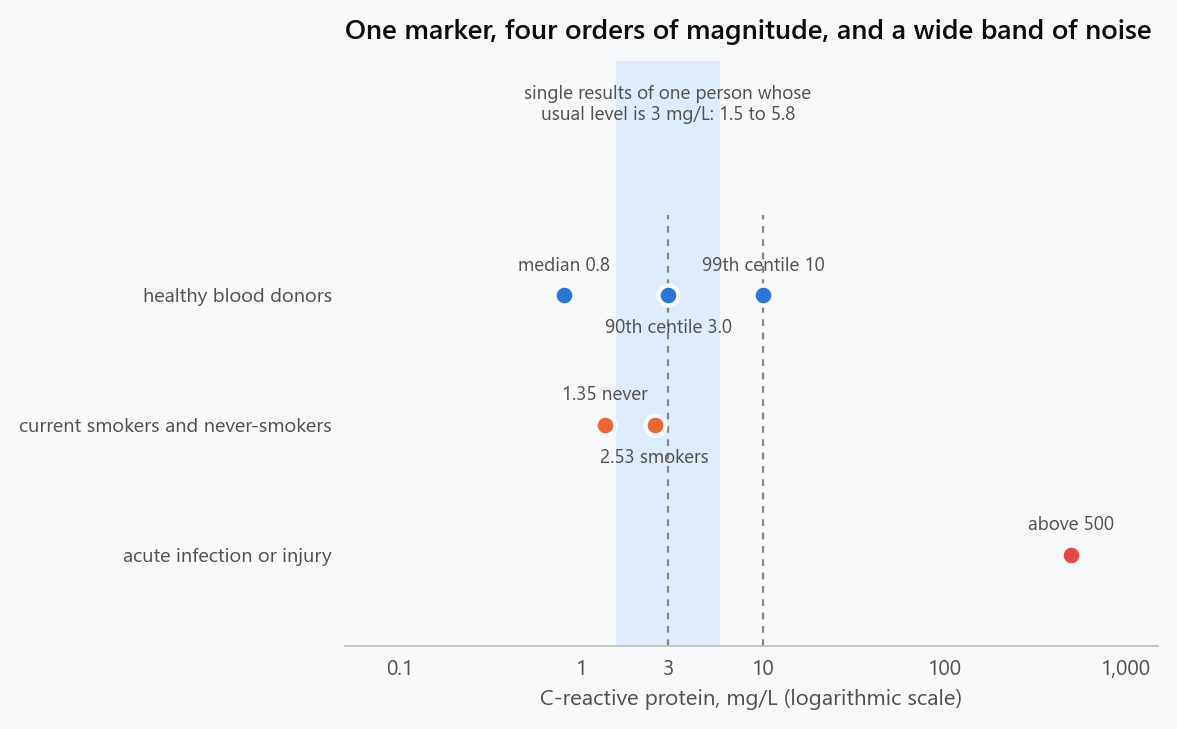
At the low end of that range, where wellness claims operate, the measurement is dominated by noise. The EFLM Biological Variation Database puts the within-person coefficient of variation of CRP at 34.7%, from six studies, against 87.1% between people. An early study found an analytical variation of 5.2% and a within-person variation of 42.2%, and reported that two successive results must differ by 118% to be unlikely to be chance; the standard formula returns 118% from those components (Macy et al., 1997). Because CRP is skewed, the threshold is better stated on a logarithmic scale. With the database figure, a second result has to be more than 155% higher or 61% lower than the first before it indicates a change, and single results from a person whose usual level is 3 mg/L will range from 1.5 to 5.8 mg/L.
Repeat measurements in real populations show what that means. In 541 participants in a United States national survey tested twice, 18.9 days apart on average, the within-person variation was 46.2%, and 32% of those above 10 mg/L on the first test were below it on the second (Bower et al., 2012). In a cohort with serial measurements, the repeatability of CRP was lower than that of cholesterol, an intraclass correlation of 0.62 against 0.75, and 69% of participants whose first value exceeded 3 mg/L, the threshold used to mark higher cardiovascular risk, had later values in a lower category (DeGoma et al., 2012). A single raised result, followed by a product and a lower result, is the expected sequence whether or not the product does anything.
What Raises CRP Besides Disease
Ordinary characteristics move CRP by amounts as large as any food or supplement is claimed to. In a representative sample of 16,616 adults in the United States, 27.6% had a CRP of 2.2 mg/L or more, and obesity multiplied the odds of being in that group by 2.13 in men and 6.21 in women (Visser et al., 1999). Among 2,920 older British men, current smokers averaged 2.53 mg/L against 1.35 mg/L in those who had never smoked, and the difference took more than twenty years to disappear after stopping (Wannamethee et al., 2005). In a randomised trial of postmenopausal hormone therapy, CRP ended 85% higher on oral hormones than on placebo (Cushman et al., 1999).
Weight change is the most important of these for judging diets. Across 33 intervention studies, CRP fell by 0.13 mg/L for each kilogram of weight lost, with a correlation of 0.85 between the two changes (Selvin et al., 2007). Any diet that produces weight loss will therefore lower CRP, whatever it contains, and a trial that does not account for weight cannot attribute the fall to a food.
A Marker Is Not a Cause
CRP does predict cardiovascular disease. In 160,309 people without vascular disease from 54 prospective studies, the risk of coronary heart disease was 1.37 times higher for each standard deviation of log CRP, after adjustment for conventional risk factors, and 1.23 after further adjustment for fibrinogen (Emerging Risk Factors Collaboration, 2010). Prediction raises the question of cause, and here the question has been answered by a natural experiment. Some people carry variants of the CRP gene that raise their CRP for life, independently of smoking, weight or anything else. If CRP caused heart disease, they would have more of it.
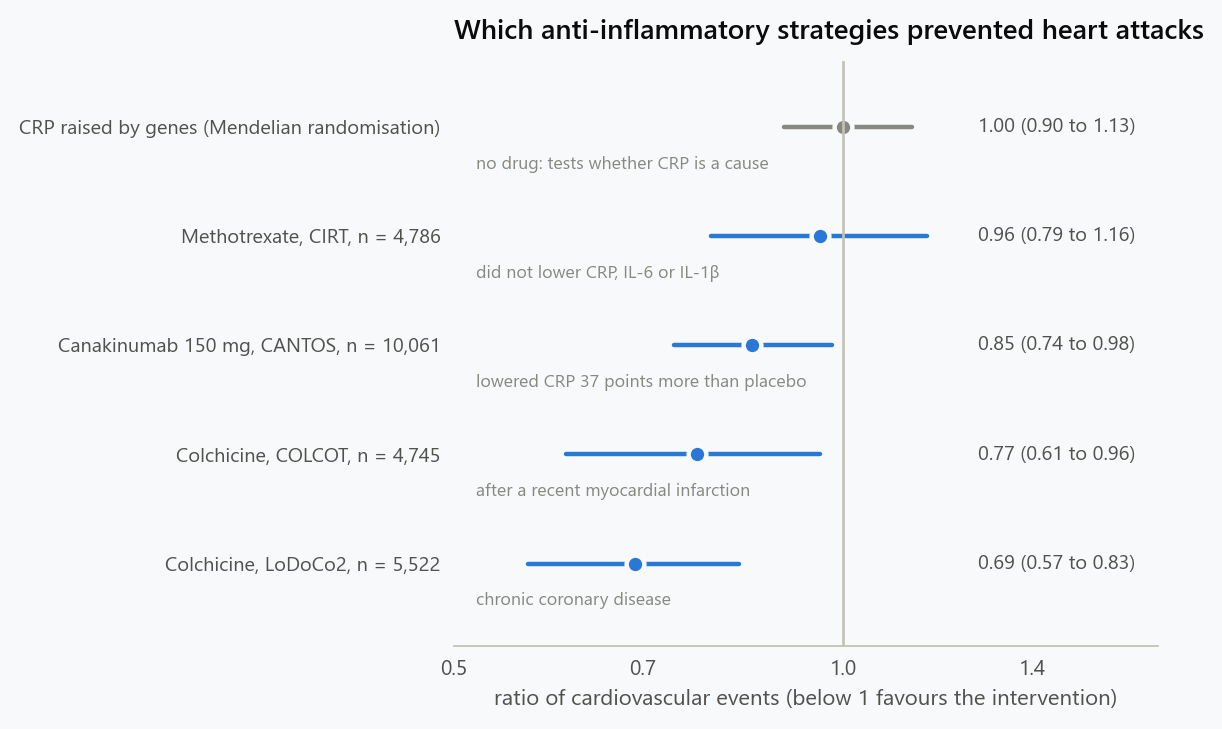
They do not. In 194,418 people, among them 46,557 with coronary heart disease, the risk ratio per standard deviation of genetically raised log CRP was 1.00, with a 95% interval from 0.90 to 1.13, against 1.33 for the same difference in measured CRP (CRP CHD Genetics Collaboration, 2011). The same method applied one step upstream gives a different answer: a variant of the interleukin-6 receptor gene that dampens interleukin-6 signalling lowers CRP by 8.35% per copy and lowers the odds of coronary disease by about 5% (IL6R MR Consortium, 2012). Part of the inflammatory pathway is causal, and CRP is a downstream readout of it. Lowering the readout is not a goal in its own right, which is the assumption beneath every product sold to reduce it.
The Trials That Tested the Idea
Few hypotheses in medicine have been tested as directly as the claim that reducing inflammation prevents heart attacks. Four large randomised trials gave anti-inflammatory drugs with no effect on cholesterol to patients with coronary disease.
| Trial | Drug and patients | Effect on markers | Cardiovascular events |
|---|---|---|---|
| CANTOS | Canakinumab, 10,061 with a previous heart attack and CRP of 2 mg/L or more | CRP 37 points lower than placebo at 150 mg | 3.86 against 4.50 per 100 person-years; hazard ratio 0.85 |
| CIRT | Low-dose methotrexate, 4,786 | No reduction in IL-1β, IL-6 or CRP | 201 against 207 events; hazard ratio 0.96 |
| COLCOT | Colchicine, 4,745 after a recent heart attack | Not the primary question | 5.5% against 7.1%; hazard ratio 0.77 |
| LoDoCo2 | Colchicine, 5,522 with chronic coronary disease | Not the primary question | 6.8% against 9.6%; hazard ratio 0.69 |
The results support the hypothesis and mark its limits. Canakinumab, an antibody against interleukin-1β, reduced events by 15% at its effective dose (Ridker et al., 2017). Methotrexate, which did not lower the inflammatory markers in these patients, did nothing (Ridker et al., 2019). Colchicine reduced events in both of its trials (Tardif et al., 2019; Nidorf et al., 2020). The target matters, and "anti-inflammatory" is not one property that any agent carrying the label shares.
The costs were equally real. In CANTOS, the 150 mg dose prevented 6.4 cardiovascular events per 1,000 person-years, and across the canakinumab groups there were 1.3 additional deaths from infection, 0.31 against 0.18 per 100 person-years, or about one fatal infection for every five events prevented. In COLCOT pneumonia was reported as a serious adverse event in 0.9% of patients on colchicine against 0.4% on placebo, and in LoDoCo2 death from non-cardiovascular causes was more frequent on colchicine, with a hazard ratio of 1.51 and an interval from 0.99 to 2.31. These are patients with established disease, in whom the benefit is worth discussing. Suppressing a defence system has a price, and for a healthy person with a CRP of 3 mg/L there is no corresponding benefit to set against it.
Exercise and Cold Water
Exercise is the clearest counterexample to the rule that a higher inflammatory marker is worse. Contracting muscle releases interleukin-6, and its concentration in blood rises up to 100-fold during exercise (Pedersen & Febbraio, 2008). That signal differs in source, duration and effect from the chronic signalling of obesity, and it is part of how exercise produces its metabolic and anti-inflammatory benefits over time (Gleeson et al., 2011). A change from baseline is not pathology. Heart rate rises during exercise and glucose rises after a meal, and nobody proposes to eliminate either.
Cold-water immersion shows what happens when the response is blunted on purpose. A Cochrane review of 17 small trials found that it reduced muscle soreness, by a standardised 0.55 at 24 hours, and rated the quality of the studies as low (Bleakley et al., 2012). In a twelve-week strength-training study of 21 men, those who recovered actively increased the area of their type II muscle fibres by 17% and their isokinetic work by 19%, and those who used cold water after each session increased neither (Roberts et al., 2015). The same intervention is useful between competitions a day apart and counterproductive when the aim is to build muscle, because part of what it suppresses is the signal for adaptation.
Diets and Supplements
Dietary patterns rich in vegetables, fruit, legumes, whole grains, nuts and unsaturated fat are associated with lower inflammatory markers (Calder et al., 2011). In 17 randomised trials with 2,300 participants, a Mediterranean diet lowered high-sensitivity CRP by 0.98 mg/L, with an $I^2$ of 91%, which means the trials disagreed widely about the size of the effect (Schwingshackl & Hoffmann, 2014). An average fall of 1 mg/L is less than a quarter of the range of single results from one person, and it is what seven or eight kilograms of weight loss would produce by itself. None of this says that the diet is not worth following. Its case rests on outcomes such as heart attacks, not on a marker, and lists of foods that "cause" or "fight" inflammation, stripped of dose and of what the food replaces, go far beyond it.
Curcumin shows how unstable supplement evidence is. An early meta-analysis of six trials with 342 participants reported a fall in CRP of 6.44 mg/L, an effect larger than that of any drug in the trials above (Sahebkar, 2014). A later one with 66 trials found 0.58 mg/L (Dehzad et al., 2023). Small early trials in selected patients give large effects that shrink as evidence accumulates, which is the usual history of a supplement. Omega-3 has been tested at scale: in 1,561 participants of the VITAL trial, a year of marine omega-3 or vitamin D did not reduce interleukin-6, tumour necrosis factor receptor 2 or CRP, and vitamin D raised interleukin-6 by 8.2% (Costenbader et al., 2019). Even where a supplement moves a marker, the genetic evidence above says why that cannot be assumed to help.
The Question to Ask
Inflammation is essential to immunity and repair, chronic inflammatory signalling contributes to disease, visceral fat promotes it, and specific anti-inflammatory drugs prevent heart attacks in people with coronary disease. None of those facts makes "inflammation" a diagnosis that symptoms can establish or a quantity that a product should minimise. The marker used to measure it ranges over four orders of magnitude, varies by a factor of two within a healthy person from one test to the next, rises with weight, smoking and oral oestrogen, and is not itself a cause of the disease it predicts.
Claims in this area usually run along a chain from mechanism to biomarker to disease to treatment, and evidence is needed at every link. A substance that activates a pathway in cultured cells, a meal that changes a cytokine and a supplement that lowers CRP are each one link. The useful question is never how to eliminate inflammation. It is what process is occurring, in which tissue, in response to what, for how long and with what clinical consequence, and that is the question immunology asks.
References
- Bleakley, C., McDonough, S., Gardner, E., Baxter, G. D., Hopkins, J. T., & Davison, G. W. (2012). Cold-water immersion (cryotherapy) for preventing and treating muscle soreness after exercise. Cochrane Database of Systematic Reviews, 2012(2), CD008262. https://doi.org/10.1002/14651858.CD008262.pub2
- Bower, J. K., Lazo, M., Juraschek, S. P., & Selvin, E. (2012). Within-person variability in high-sensitivity C-reactive protein. Archives of Internal Medicine, 172(19), 1519-1521. https://doi.org/10.1001/archinternmed.2012.3712
- Calder, P. C., Ahluwalia, N., Brouns, F., Buetler, T., Clement, K., Cunningham, K., … Winklhofer-Roob, B. M. (2011). Dietary factors and low-grade inflammation in relation to overweight and obesity. British Journal of Nutrition, 106(S3), S5-S78. https://doi.org/10.1017/S0007114511005460
- Costenbader, K. H., MacFarlane, L. A., Lee, I. M., Buring, J. E., Mora, S., Bubes, V., … Cook, N. R. (2019). Effects of one year of vitamin D and marine omega-3 fatty acid supplementation on biomarkers of systemic inflammation in older US adults. Clinical Chemistry, 65(12), 1508-1521. https://doi.org/10.1373/clinchem.2019.306902
- CRP CHD Genetics Collaboration (2011). Association between C reactive protein and coronary heart disease: mendelian randomisation analysis based on individual participant data. BMJ, 342, d548. https://doi.org/10.1136/bmj.d548
- Cushman, M., Legault, C., Barrett-Connor, E., Stefanick, M. L., Kessler, C., Judd, H. L., Sakkinen, P. A., & Tracy, R. P. (1999). Effect of postmenopausal hormones on inflammation-sensitive proteins: the Postmenopausal Estrogen/Progestin Interventions (PEPI) study. Circulation, 100(7), 717-722. https://doi.org/10.1161/01.cir.100.7.717
- DeGoma, E. M., French, B., Dunbar, R. L., Allison, M. A., Mohler, E. R., & Budoff, M. J. (2012). Intraindividual variability of C-reactive protein: the Multi-Ethnic Study of Atherosclerosis. Atherosclerosis, 224(1), 274-279. https://doi.org/10.1016/j.atherosclerosis.2012.07.017
- Dehzad, M. J., Ghalandari, H., Nouri, M., & Askarpour, M. (2023). Antioxidant and anti-inflammatory effects of curcumin/turmeric supplementation in adults: a GRADE-assessed systematic review and dose-response meta-analysis of randomized controlled trials. Cytokine, 164, 156144. https://doi.org/10.1016/j.cyto.2023.156144
- Emerging Risk Factors Collaboration (2010). C-reactive protein concentration and risk of coronary heart disease, stroke, and mortality: an individual participant meta-analysis. The Lancet, 375(9709), 132-140. https://doi.org/10.1016/S0140-6736(09)61717-7
- European Federation of Clinical Chemistry and Laboratory Medicine. EFLM Biological Variation Database. https://biologicalvariation.eu
- Furman, D., Campisi, J., Verdin, E., Carrera-Bastos, P., Targ, S., Franceschi, C., … Slavich, G. M. (2019). Chronic inflammation in the etiology of disease across the life span. Nature Medicine, 25(12), 1822-1832. https://doi.org/10.1038/s41591-019-0675-0
- Gleeson, M., Bishop, N. C., Stensel, D. J., Lindley, M. R., Mastana, S. S., & Nimmo, M. A. (2011). The anti-inflammatory effects of exercise: mechanisms and implications for the prevention and treatment of disease. Nature Reviews Immunology, 11(9), 607-615. https://doi.org/10.1038/nri3041
- Hotamisligil, G. S. (2006). Inflammation and metabolic disorders. Nature, 444(7121), 860-867. https://doi.org/10.1038/nature05485
- IL6R MR Consortium (2012). The interleukin-6 receptor as a target for prevention of coronary heart disease: a mendelian randomisation analysis. The Lancet, 379(9822), 1214-1224. https://doi.org/10.1016/S0140-6736(12)60110-X
- Macy, E. M., Hayes, T. E., & Tracy, R. P. (1997). Variability in the measurement of C-reactive protein in healthy subjects: implications for reference intervals and epidemiological applications. Clinical Chemistry, 43(1), 52-58.
- Medzhitov, R. (2008). Origin and physiological roles of inflammation. Nature, 454(7203), 428-435. https://doi.org/10.1038/nature07201
- Nidorf, S. M., Fiolet, A. T. L., Mosterd, A., Eikelboom, J. W., Schut, A., Opstal, T. S. J., … Thompson, P. L. (2020). Colchicine in patients with chronic coronary disease. New England Journal of Medicine, 383(19), 1838-1847. https://doi.org/10.1056/NEJMoa2021372
- Pedersen, B. K., & Febbraio, M. A. (2008). Muscle as an endocrine organ: focus on muscle-derived interleukin-6. Physiological Reviews, 88(4), 1379-1406. https://doi.org/10.1152/physrev.90100.2007
- Pepys, M. B., & Hirschfield, G. M. (2003). C-reactive protein: a critical update. Journal of Clinical Investigation, 111(12), 1805-1812. https://doi.org/10.1172/JCI18921
- Ridker, P. M., Everett, B. M., Thuren, T., MacFadyen, J. G., Chang, W. H., Ballantyne, C., … Glynn, R. J. (2017). Antiinflammatory therapy with canakinumab for atherosclerotic disease. New England Journal of Medicine, 377(12), 1119-1131. https://doi.org/10.1056/NEJMoa1707914
- Ridker, P. M., Everett, B. M., Pradhan, A., MacFadyen, J. G., Solomon, D. H., Zaharris, E., … Glynn, R. J. (2019). Low-dose methotrexate for the prevention of atherosclerotic events. New England Journal of Medicine, 380(8), 752-762. https://doi.org/10.1056/NEJMoa1809798
- Roberts, L. A., Raastad, T., Markworth, J. F., Figueiredo, V. C., Egner, I. M., Shield, A., … Peake, J. M. (2015). Post-exercise cold water immersion attenuates acute anabolic signalling and long-term adaptations in muscle to strength training. Journal of Physiology, 593(18), 4285-4301. https://doi.org/10.1113/JP270570
- Sahebkar, A. (2014). Are curcuminoids effective C-reactive protein-lowering agents in clinical practice? Evidence from a meta-analysis. Phytotherapy Research, 28(5), 633-642. https://doi.org/10.1002/ptr.5045
- Schwingshackl, L., & Hoffmann, G. (2014). Mediterranean dietary pattern, inflammation and endothelial function: a systematic review and meta-analysis of intervention trials. Nutrition, Metabolism and Cardiovascular Diseases, 24(9), 929-939. https://doi.org/10.1016/j.numecd.2014.03.003
- Selvin, E., Paynter, N. P., & Erlinger, T. P. (2007). The effect of weight loss on C-reactive protein: a systematic review. Archives of Internal Medicine, 167(1), 31-39. https://doi.org/10.1001/archinte.167.1.31
- Tardif, J. C., Kouz, S., Waters, D. D., Bertrand, O. F., Diaz, R., Maggioni, A. P., … Roubille, F. (2019). Efficacy and safety of low-dose colchicine after myocardial infarction. New England Journal of Medicine, 381(26), 2497-2505. https://doi.org/10.1056/NEJMoa1912388
- Visser, M., Bouter, L. M., McQuillan, G. M., Wener, M. H., & Harris, T. B. (1999). Elevated C-reactive protein levels in overweight and obese adults. JAMA, 282(22), 2131-2135. https://doi.org/10.1001/jama.282.22.2131
- Wannamethee, S. G., Lowe, G. D., Shaper, A. G., Rumley, A., Lennon, L., & Whincup, P. H. (2005). Associations between cigarette smoking, pipe/cigar smoking, and smoking cessation, and haemostatic and inflammatory markers for cardiovascular disease. European Heart Journal, 26(17), 1765-1773. https://doi.org/10.1093/eurheartj/ehi183
Embed interactive plots, widgets, and demos using <figure>, <iframe>, or <div class="interactive-embed"> containers. Ensure each embed includes descriptive captions for accessibility.
How to cite
Use the quick export buttons to save citations for reference managers or copy the formatted text directly.
Diogo Ribeiro (2026). Inflammation Is Not a Diagnosis. Faculty of Media Arts and Design, Technical University of Porto. https://diogoribeiro7.github.io/healthcare/inflammation_is_not_a_diagnosis_social_media_myths/.