Topics
A recurring argument in discussions of aspartame is that its breakdown products also occur in ordinary foods. It is meant to reassure: if the body meets the same molecules after eating fruit, concern about the sweetener must be misplaced. The premise is true and useful. After ingestion aspartame is hydrolysed in the gut into phenylalanine, aspartic acid and methanol, none of which is unique to a sweetener. Phenylalanine and aspartic acid are amino acids present in every protein, and methanol is released from the pectin in fruit and produced by the body's own metabolism.
That is relevant toxicology, and it is not a safety argument. Two questions are being run together: whether a molecule is familiar to human metabolism, and whether a particular exposure to it is safe. The first is about identity and the second about dose. This essay keeps the argument and supplies the part it leaves out, because in this case the missing quantities are published and the arithmetic takes a few lines.
Why the Metabolites Are the Right Subject
Aspartame is the methyl ester of a dipeptide of aspartic acid and phenylalanine. The Joint FAO/WHO Expert Committee on Food Additives concludes that it is fully hydrolysed in the gastrointestinal tract and that no aspartame enters the circulation as such, which changes the toxicological question. If the parent compound never reaches the blood, risk assessment is about its three products and how much of each arrives. On hydrolysis about 10% of the weight of aspartame becomes methanol, and the phenylalanine released amounts to 56% of it (EFSA, 2013; WHO, 1997).
The observation that those products are chemically identical to compounds from food is therefore not a rhetorical curiosity. It means that the body is not meeting three exotic substances that exist only because a sweetener was invented, and the European Food Safety Authority uses ordinary foods in exactly this way to put exposure in context. The difficulty begins when relevant is quietly upgraded to sufficient.
What Natural Occurrence Cannot Show
That a compound occurs in fruit does not make every dose of it harmless. Methanol is the example to hand. Small amounts come from diet and from normal metabolism, and large amounts are poisonous because methanol is metabolised to formate, which accumulates. Normal blood methanol is below 0.5 mg/L. Effects on the nervous system appear above about 200 mg/L and on the eye above 500 mg/L, deaths in untreated patients have followed initial levels of 1,500 to 2,000 mg/L, and the minimum lethal dose is put at 0.3 to 1 g per kilogram of body weight (WHO, 1997). Sodium, vitamin A and iron have the same structure: necessary or ordinary at one dose and harmful at another.
The opposite argument is no better. A substance is not dangerous because it is synthetic, and two identical methanol molecules are handled identically whatever their history. The natural-against-artificial framing invites an argument about origin when the variables that matter are dose and kinetics, so the scientific position is symmetrical: natural occurrence does not guarantee safety and synthetic origin does not establish toxicity. Both sides of the online argument need the numbers.
Methanol by Source
European law allows up to 600 mg of aspartame per litre of soft drink, so a 330 mL can contains at most 198 mg and yields at most 19.8 mg of methanol. Drinks on the shelf contain much less. Two surveys of soft drinks sold in Portugal found mean aspartame concentrations of 89 mg/L and 161.5 mg/L (Lino et al., 2008; Basílio et al., 2020), which put a can at 29 to 53 mg of aspartame and 3 to 5 mg of methanol.
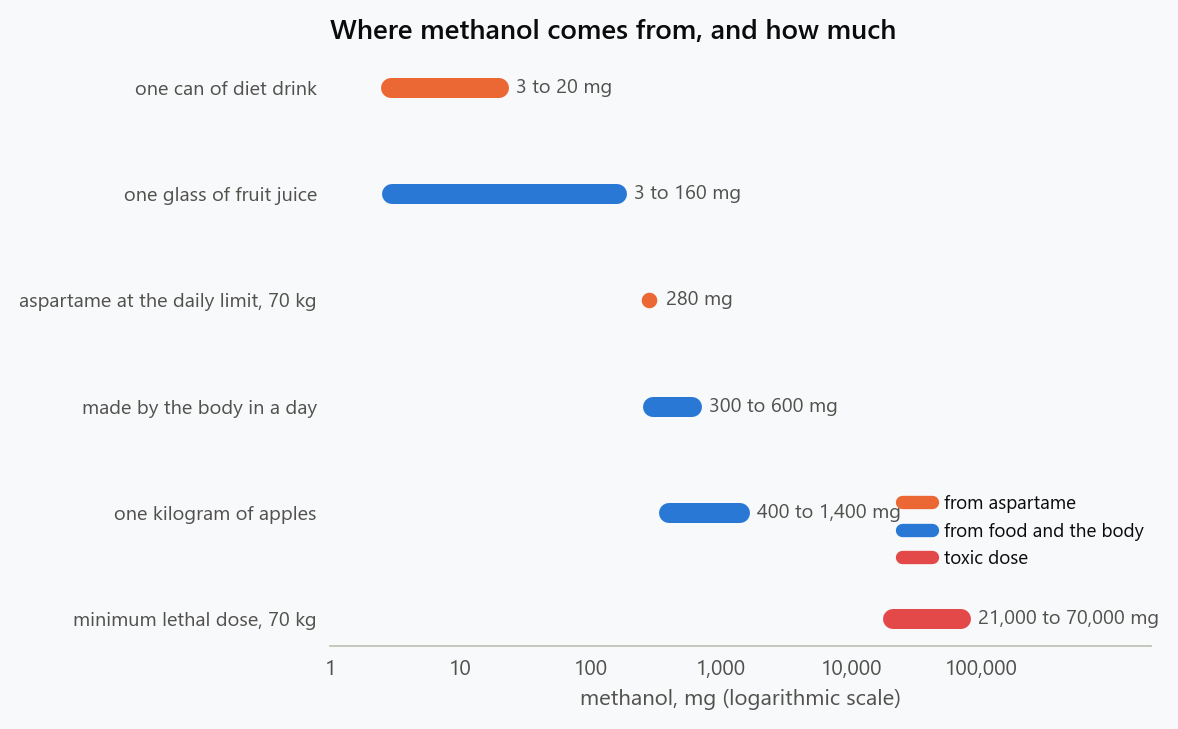
Fruit juice contains 12 to 640 mg of methanol per litre, with a mean of 140 mg/L, so a 250 mL glass yields 3 to 160 mg and 35 mg on average (WHO, 1997). The pectin in a kilogram of apples releases 0.4 to 1.4 g in the gut, about as much as the body makes unaided, which was measured at 0.3 to 0.6 g a day (Lindinger et al., 1997). EFSA's exposure assessment reaches the same conclusion from survey data: aspartame contributes less than 10% of the methanol a person is exposed to from all sources.
| Source | Amount | Methanol |
|---|---|---|
| Can of diet drink, as measured | 29 to 53 mg of aspartame | 3 to 5 mg |
| Can of diet drink, at the legal maximum | 198 mg of aspartame | 19.8 mg |
| Glass of fruit juice | 250 mL | 3 to 160 mg |
| Aspartame at the acceptable daily intake, 70 kg adult | 2,800 mg of aspartame | 280 mg |
| Made by the body | one day | 300 to 600 mg |
| Apples | 1 kg | 400 to 1,400 mg |
| Minimum lethal dose, 70 kg adult | 21,000 to 70,000 mg |
This is where the fruit argument becomes a real one. It was never enough to say that fruit contains methanol. What carries weight is that a can delivers less methanol than a glass of juice, that a person who consumed aspartame at the acceptable daily intake every day would add less than the body makes unaided, and that the lethal dose is a hundred times beyond that.
Does the Arithmetic Predict the Blood?
A calculation of this kind can be checked, because aspartame has been given to volunteers in large single doses and their blood methanol measured. If a tenth of the dose becomes methanol and distributes through the body water, with a volume of distribution of 0.77 L per kilogram (EFSA, 2013), the peak concentration after a dose of $D$ mg of aspartame per kilogram is at most
In 30 adults given 100, 150 and 200 mg/kg, which is several days' worth of the acceptable intake at once, mean peak blood methanol was 12.7, 21.4 and 25.8 mg/L (Stegink et al., 1981). The formula predicts 13.0, 19.5 and 26.0. At 34 mg/kg, the dose then taken to represent the 99th percentile of daily consumption, methanol was below the assay's detection limit of 4 mg/L in all twelve subjects; the prediction is 4.4 mg/L, so the correct reading of that result is a rise too small to measure, not the absence of one.
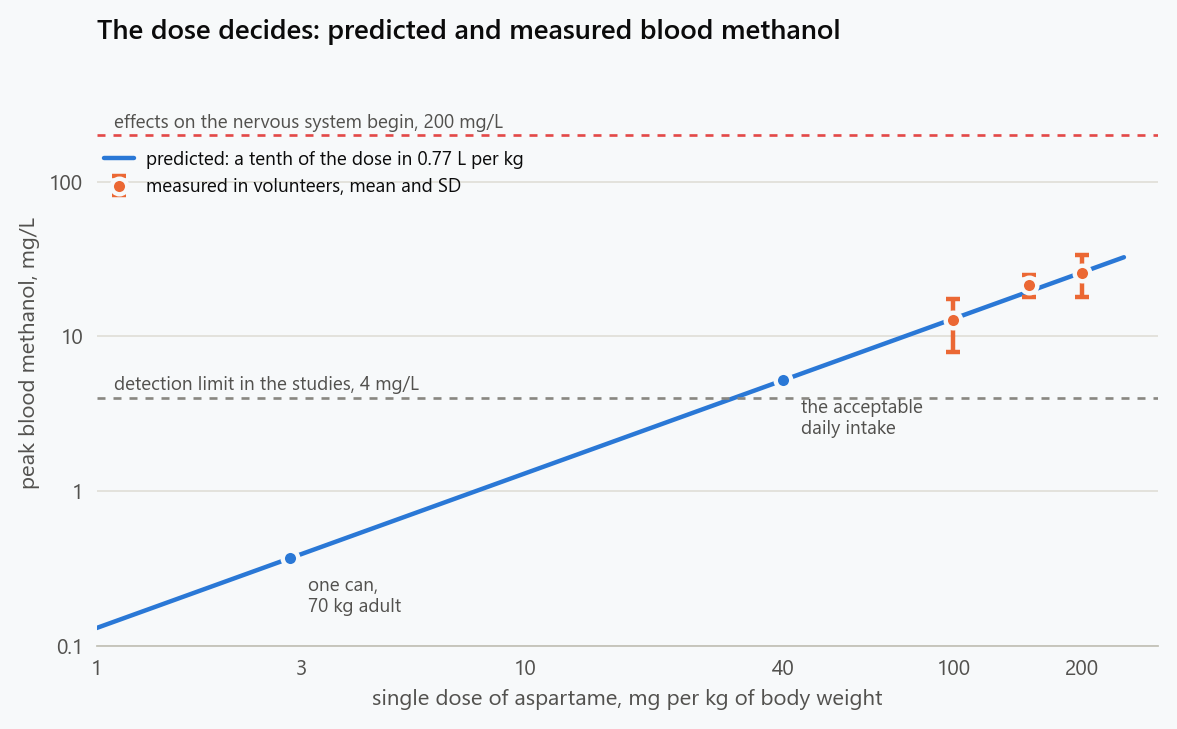
With the model checked, it can be applied where measurement is impossible. One can at the legal maximum, drunk by a 70 kg adult, predicts a rise of 0.37 mg/L, less than normal background, and the threshold for effects on the nervous system is 544 times higher. The whole acceptable daily intake swallowed in one dose predicts 5.2 mg/L. In six adults given eight successive hourly servings of 600 mg, each the amount in about a litre of diet drink, blood methanol and formate stayed within normal limits (Stegink et al., 1989). The margin is measured in hundreds.
Intake, the Acceptable Intake and What It Means
The acceptable daily intake is 40 mg per kilogram per day in the JECFA and EFSA evaluations and 50 mg in the United States, which for a 70 kg adult is 2,800 mg. It is not a threshold at which harm begins. It is an estimate of a daily exposure that can be maintained for a lifetime without appreciable risk, set well below the doses that produced no effect in animals. At the legal maximum a 70 kg adult reaches it with 14.1 cans a day and a 20 kg child with 4.0. At the concentrations actually found in drinks, the figures are 52 to 95 cans for the adult and 15 to 27 for the child.
Measured consumption sits below the limit and, for children, not always far below. EFSA's estimates for high consumers, the 95th percentile, reach 36.0 mg/kg a day in toddlers, 32.4 in children and 27.5 in adults, which are 90%, 81% and 69% of the acceptable intake, under deliberately conservative assumptions about how much each food contains. That is the honest summary of the margin: very large for methanol toxicity, comfortable for the average consumer, and thin enough for small children with a heavy intake of sweetened products that it was worth a regulator's attention.
Hazard, Risk and the 2023 Classification
In July 2023 the International Agency for Research on Cancer classified aspartame as possibly carcinogenic to humans, Group 2B, judging the evidence limited in humans, limited in animals and limited for mechanisms. On the same day JECFA published its assessment, found no convincing evidence of adverse effects after ingestion, and kept the acceptable daily intake at 40 mg/kg. The two statements were widely reported as a contradiction and are answers to different questions. IARC identifies hazards: it grades the strength of evidence that an agent can cause cancer under some circumstances and says nothing about how likely that is at a given dose. Risk assessment asks what the hazard means at actual exposures.
The human evidence is worth seeing at its real size. In the French NutriNet-Santé cohort of 102,865 adults followed for a median of 7.8 years, higher consumers of aspartame had a hazard ratio for cancer of 1.15, with a 95% interval from 1.03 to 1.28, compared with non-consumers (Debras et al., 2022). The higher consumers averaged 47.42 mg a day, which is 1.7% of the acceptable intake for a 70 kg adult, about one can. An association of that size in an observational study, where people who choose diet products differ from those who do not in weight, diabetes and much else, is a reason to keep studying and cannot settle the question. It is the kind of evidence that "limited" describes.
Who the Warning Is For
Phenylalanine shows why a safety statement needs a population attached. A can at the maximum level yields 111 mg of it, and an ordinary diet supplies 0.9 to 4.1 g a day, to which aspartame adds 1% to 8% (EFSA, 2013). For nearly everyone that is nutritionally trivial. People with phenylketonuria cannot metabolise phenylalanine normally and have to restrict it for life, which is why products containing aspartame must state that they contain a source of phenylalanine. The warning does not contradict the general assessment. It shows that a molecule which is ordinary in one metabolism is clinically important in another, and that is a better argument for careful risk assessment than any appeal to what is natural.
Safety and usefulness are separate questions as well. EFSA and JECFA address toxicology. The World Health Organization's 2023 guideline on non-sugar sweeteners addressed a different matter, whether they should be used as a means of long-term weight control, and made a conditional recommendation against it, for people without diabetes. A substance can be safe at expected exposure and still be unnecessary or of doubtful value for a particular goal, and a drink that contains it is not made healthy by the additive's safety. Safe, healthy, necessary and better than the alternative are different predicates, and online arguments tend to merge them.
A True Premise and an Incomplete Argument
The argument from fruit illustrates a general error. A true statement can be relevant without being sufficient. That the metabolites occur in ordinary food contributes to the assessment, because it supplies chemical identity and background exposure, and it cannot replace dose-response data, long-term studies, epidemiology, susceptible groups and regulatory analysis. A conclusion can be broadly right while a popular route to it is incomplete, and correct answers do not make every argument for them valid.
The stronger version is available to anyone willing to do the arithmetic. A can yields 3 to 20 mg of methanol, a glass of juice up to 160 mg, and the body makes 300 to 600 mg a day. A simple model predicts measured blood levels to within 10%, and says that the rise from one can is a few hundred times below the level at which effects begin. High consumers among small children approach the acceptable intake, and people with phenylketonuria must avoid the compound altogether. That is less memorable than an analogy with fruit, and it is the argument that matters.
References
- Basílio, M., Silva, L. J. G., Pereira, A. M. P. T., Pena, A., & Lino, C. M. (2020). Artificial sweeteners in non-alcoholic beverages: occurrence and exposure estimation of the Portuguese population. Food Additives & Contaminants: Part A, 37(12), 2040-2050. https://doi.org/10.1080/19440049.2020.1812734
- Debras, C., Chazelas, E., Srour, B., Druesne-Pecollo, N., Esseddik, Y., Szabo de Edelenyi, F., … Touvier, M. (2022). Artificial sweeteners and cancer risk: results from the NutriNet-Santé population-based cohort study. PLoS Medicine, 19(3), e1003950. https://doi.org/10.1371/journal.pmed.1003950
- EFSA Panel on Food Additives and Nutrient Sources added to Food (2013). Scientific opinion on the re-evaluation of aspartame (E 951) as a food additive. EFSA Journal, 11(12), 3496. https://doi.org/10.2903/j.efsa.2013.3496
- International Agency for Research on Cancer & Joint FAO/WHO Expert Committee on Food Additives (2023). Summary of findings of the evaluation of aspartame. https://www.iarc.who.int/wp-content/uploads/2023/07/Summary_of_findings_Aspartame.pdf
- Joint FAO/WHO Expert Committee on Food Additives. Aspartame. https://apps.who.int/food-additives-contaminants-jecfa-database/Home/Chemical/62
- Lindinger, W., Taucher, J., Jordan, A., Hansel, A., & Vogel, W. (1997). Endogenous production of methanol after the consumption of fruit. Alcoholism: Clinical and Experimental Research, 21(5), 939-943.
- Lino, C. M., Costa, I. M., Pena, A., Ferreira, R., & Cardoso, S. M. (2008). Estimated intake of the sweeteners, acesulfame-K and aspartame, from soft drinks, soft drinks based on mineral waters and nectars for a group of Portuguese teenage students. Food Additives & Contaminants: Part A, 25(11), 1291-1296. https://doi.org/10.1080/02652030802195309
- Stegink, L. D., Brummel, M. C., McMartin, K., Martin-Amat, G., Filer, L. J., Baker, G. L., & Tephly, T. R. (1981). Blood methanol concentrations in normal adult subjects administered abuse doses of aspartame. Journal of Toxicology and Environmental Health, 7(2), 281-290. https://doi.org/10.1080/15287398109529979
- Stegink, L. D., Filer, L. J., Bell, E. F., Ziegler, E. E., & Tephly, T. R. (1989). Effect of repeated ingestion of aspartame-sweetened beverage on plasma amino acid, blood methanol, and blood formate concentrations in normal adults. Metabolism, 38(4), 357-363. https://doi.org/10.1016/0026-0495(89)90125-x
- US Food and Drug Administration. Aspartame and other sweeteners in food. https://www.fda.gov/food/food-additives-petitions/aspartame-and-other-sweeteners-food
- World Health Organization (1997). Methanol. Environmental Health Criteria 196. International Programme on Chemical Safety. https://www.inchem.org/documents/ehc/ehc/ehc196.htm
- World Health Organization (2023). Use of non-sugar sweeteners: WHO guideline. https://www.who.int/publications/i/item/9789240073616
Embed interactive plots, widgets, and demos using <figure>, <iframe>, or <div class="interactive-embed"> containers. Ensure each embed includes descriptive captions for accessibility.
How to cite
Use the quick export buttons to save citations for reference managers or copy the formatted text directly.
Diogo Ribeiro (2026). Aspartame, Fruit and the Difference Between a Relevant Fact and a Complete Safety Argument. Faculty of Media Arts and Design, Technical University of Porto. https://diogoribeiro7.github.io/healthcare/aspartame_fruit_true_premise_bad_argument/.