Topics
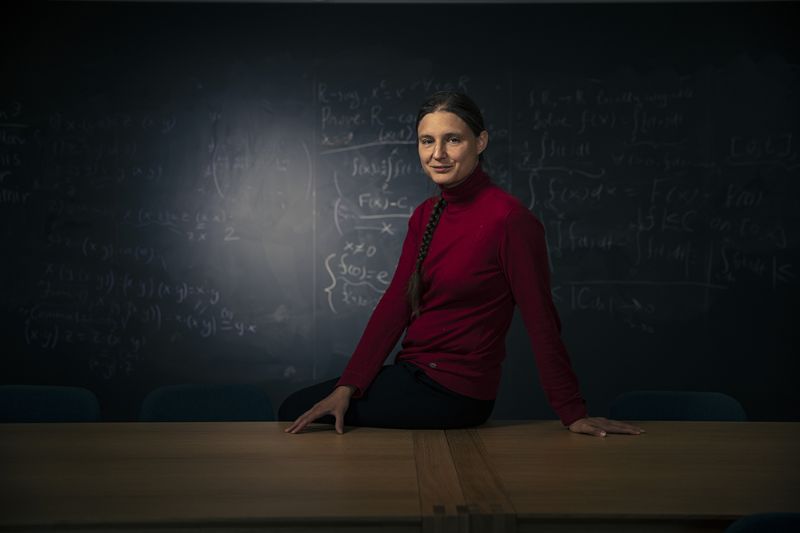
Marina Viazovska received the 2022 Fields Medal for contributions centered on the sphere-packing problem in dimensions 8 and 24 and related advances in interpolation and discrete geometry.
The importance of the result is not simply that a difficult packing problem was solved. The proof identified a previously missing analytic structure linking optimal lattices, Fourier analysis, and modular forms.
The sphere-packing problem
In $d$ dimensions, one asks for the largest possible density of non-overlapping congruent balls.
For a lattice packing generated by lattice $\Lambda$, density depends on the shortest nonzero lattice vector and the determinant of the lattice.
In dimension 8, the highly symmetric $E_8$ lattice had long been expected to be optimal.
The difficulty was proving that no non-lattice or irregular packing could do better.
Cohn-Elkies linear programming bounds
Before Viazovska's breakthrough, Cohn and Elkies developed a Fourier-analytic upper bound for sphere packing.
Very roughly, one seeks an auxiliary function $f:\mathbb R^d\to\mathbb R$ satisfying sign conditions on both $f$ and its Fourier transform $\widehat f$.
If the function is chosen correctly, Poisson summation and positivity yield an upper bound on packing density.
The numerical evidence in dimensions 8 and 24 was extraordinarily sharp, suggesting that an exact optimal auxiliary function should exist.
The missing piece was constructing it.
Viazovska's construction
Viazovska used modular and quasimodular forms to construct the exact radial Schwartz function required in dimension 8.
The function had prescribed zeros at radii corresponding to nonzero vectors of $E_8$ and matched the conditions needed for equality in the Cohn-Elkies bound.
That equality proves not only that $E_8$ is very dense, but that no sphere packing in $\mathbb R^8$ can exceed its density.
This is why the proof was so striking: a numerical linear-programming bound became an exact theorem through an explicit analytic construction.
Why dimension 8 is special
The $E_8$ lattice is exceptional in many areas of mathematics.
Its symmetry, theta series, modular properties, and extremal geometry align unusually well with the analytic machinery.
The result does not mean the same method solves sphere packing in arbitrary dimension. Dimensions 8 and 24 possess exceptional algebraic structures.
Dimension 24
Soon after the dimension-8 proof, Viazovska, Henry Cohn, Abhinav Kumar, Stephen Miller, and Danylo Radchenko extended the method to dimension 24.
There the Leech lattice is optimal.
The dimension-24 construction is more involved, but the same broad framework connects modular forms and Fourier interpolation to the linear-programming bound.
Universal optimality
The later work went beyond sphere packing.
For certain energy-minimization problems, $E_8$ and the Leech lattice are universally optimal: they minimize a broad family of potential energies among configurations of a given density.
This places sphere packing inside a wider optimization theory for point configurations.
Interpolation formulas
Another major contribution of this line of work is the discovery of interpolation formulas for radial Schwartz functions in dimensions 8 and 24.
These formulas reconstruct functions from discrete information related to special radii and Fourier transforms.
That phenomenon helps explain why exact extremizers exist in these exceptional dimensions.
Biography in context
Viazovska was born in Kyiv in 1984 and studied mathematics in Ukraine and Germany, receiving her doctorate from the University of Bonn.
Her research before the sphere-packing result already involved modular forms, number theory, and mathematical physics.
That background was directly relevant to the eventual proof; the modular-form machinery was not an unrelated trick imported after the fact.
Why the result matters
The proof is a good example of mathematical progress through interaction between fields.
The sphere-packing problem is geometric. The upper bound is Fourier analytic. The exact construction comes from modular forms. The optimal configuration is an exceptional lattice.
None of those viewpoints alone explains the whole proof.
Conclusion
Viazovska's achievement should be understood mathematically rather than primarily through biography or representation.
She solved the eight-dimensional sphere-packing problem by constructing the exact analytic object that decades of numerical and theoretical work had indicated should exist.
The result connected discrete geometry, harmonic analysis, modular forms, and optimization in a way that has generated further mathematics beyond the original packing problem.
References
- Viazovska, M. S. (2017). The sphere packing problem in dimension 8. Annals of Mathematics, 185(3), 991-1015.
- Cohn, H., Kumar, A., Miller, S. D., Radchenko, D., & Viazovska, M. (2017). The sphere packing problem in dimension 24. Annals of Mathematics, 185(3), 1017-1033.
- Cohn, H., & Elkies, N. (2003). New upper bounds on sphere packings I. Annals of Mathematics.
Embed interactive plots, widgets, and demos using <figure>, <iframe>, or <div class="interactive-embed"> containers. Ensure each embed includes descriptive captions for accessibility.
How to cite
Use the quick export buttons to save citations for reference managers or copy the formatted text directly.
Diogo Ribeiro (2024). Marina Viazovska and the E8 Sphere-Packing Proof. Faculty of Media Arts and Design, Technical University of Porto. https://diogoribeiro7.github.io/mathematics/marina_viazovska_fields_medalist_and_pioneer_in_sphere_packing/.