Topics
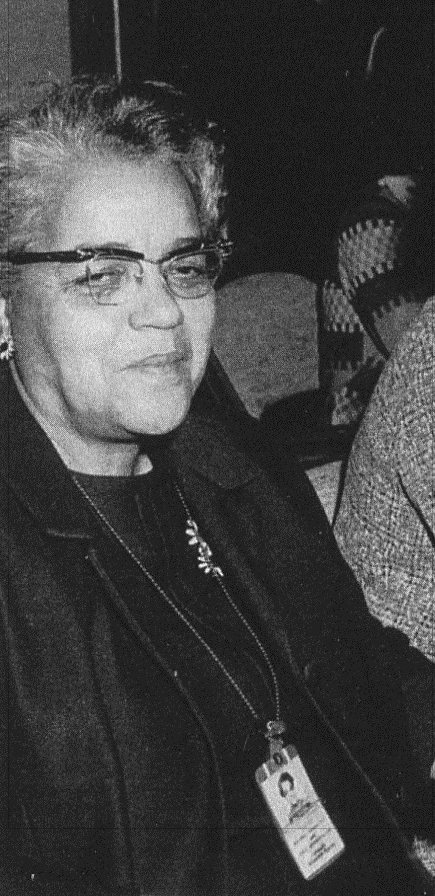
Dorothy Vaughan
Dorothy Vaughan: Leadership, Computing, and Langley
Dorothy Johnson Vaughan (1910–2008) was a mathematician, supervisor, and programmer whose career spanned the transition from hand computation to electronic computing at NACA and NASA. The historically precise description matters. Vaughan did not “lead NASA's computing division.” She led the segregated West Area Computing unit at NACA from 1949 until 1958, becoming NACA's first Black supervisor and one of its few female supervisors. When NACA became NASA and segregated work units were abolished, she joined the integrated Analysis and Computation Division.
Education and teaching
Vaughan was born in Kansas City, Missouri, in 1910 and later moved with her family to West Virginia. She received a full-tuition scholarship to Wilberforce University and graduated in 1929 with a mathematics degree. Before entering aeronautical research, she taught mathematics at Robert Russa Moton High School in Farmville, Virginia.
West Area Computing
Vaughan joined the Langley Memorial Aeronautical Laboratory in December 1943 during World War II. She was assigned to the segregated West Area Computing unit, where Black women mathematicians performed calculations for aeronautical research. The work involved slide rules, mechanical calculators, data from wind-tunnel and flight experiments, and the production of engineering quantities used by researchers.
In 1949 Vaughan became acting head of the group and later its formal section head. NASA's historical account emphasizes two roles:
- technical competence in difficult computations;
- management and advocacy for the women assigned to West Computing.
Engineers often requested particular computers for projects, and Vaughan was involved in assigning people to work that matched their skills.
From mechanical calculation to electronic computing
By the late 1950s, electronic computers were changing Langley's workflow. When NASA was created in 1958, segregated units were abolished and Vaughan moved into the Analysis and Computation Division. She became an expert FORTRAN programmer. That transition is one of the most important parts of her career. The mathematical task changed from
to
Vaughan adapted to that change and helped others do the same.
FORTRAN
FORTRAN was designed for scientific and engineering computation. A simple numerical algorithm that had previously been executed manually could now be encoded as a program operating on arrays, loops, and floating-point arithmetic. The important historical point is not that Vaughan “invented” such programming. It is that she learned and used the new computational language early enough to remain technically relevant as human computing was displaced by electronic computing.
Scout Launch Vehicle Program
NASA records that Vaughan contributed to the Scout Launch Vehicle Program. Scout was a solid-fueled launch-vehicle system developed for small satellite missions. Her work therefore extended beyond generic computer programming into aerospace computations associated with an operational NASA program. The earlier version's broad statements about Mercury and Apollo were too unspecific.
The strongest documented program-specific claim is her contribution to Scout.
Leadership under segregation
Vaughan's management role existed inside a segregated institution. That context should not be reduced to an inspirational story about personal persistence. The structure of NACA limited who could work where and under what conditions. Within those constraints, Vaughan became the first Black supervisor at NACA and advocated for the advancement of computers working under her and elsewhere.
Her leadership was institutional as well as technical.
Hidden Figures and public memory
Margot Lee Shetterly's Hidden Figures brought Vaughan's work, together with that of Katherine Johnson, Mary Jackson, and other Black women at Langley, to a much wider audience. The film adaptation compresses people and timelines for narrative purposes. For technical and historical claims, NASA archival material and Shetterly's research are better sources than the dramatized film.
Retirement
Vaughan retired from NASA in 1971 after a 28-year career. She had participated in three distinct technological eras:
That transition is a substantial technical history in its own right.
Conclusion
Dorothy Vaughan's importance rests on documented contributions:
- leadership of West Area Computing;
- technical work at Langley;
- adaptation to electronic computation;
- FORTRAN programming;
- work in the Analysis and Computation Division;
- contribution to the Scout Launch Vehicle Program;
- advocacy for colleagues in a segregated institution.
That record is stronger than generic claims that she “helped launch America into space.”
References
- NASA. Dorothy Vaughan. NASA People and Langley historical biography.
- NASA Langley Research Center. Dorothy J. Vaughan.
- Shetterly, M. L. (2016). Hidden Figures. William Morrow.
Embed interactive plots, widgets, and demos using <figure>, <iframe>, or <div class="interactive-embed"> containers. Ensure each embed includes descriptive captions for accessibility.
How to cite
Use the quick export buttons to save citations for reference managers or copy the formatted text directly.
Diogo Ribeiro (2022). Dorothy Vaughan: Pioneering Mathematician and NASA Computer Scientist. Faculty of Media Arts and Design, Technical University of Porto. https://diogoribeiro7.github.io/mathematics/dorothy_vaughan_pioneering_mathematician_and_nasa_computer_scientist/.