Topics
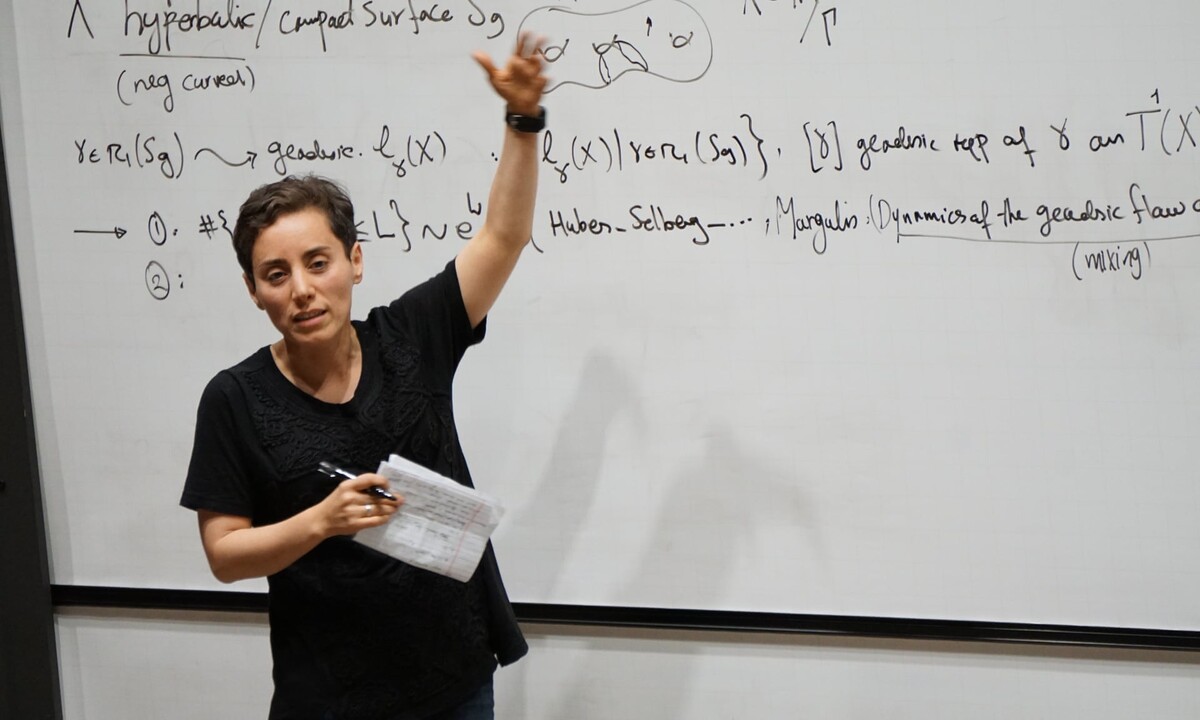
Maryam Mirzakhani
Maryam Mirzakhani (1977–2017) changed the study of hyperbolic surfaces and moduli spaces by connecting geometry, topology, dynamics, and probability in ways that had not previously been available. In 2014 she became the first woman to receive a Fields Medal. The official citation recognized her
outstanding contributions to the dynamics and geometry of Riemann surfaces and their moduli spaces.
That wording is precise enough to organize the mathematics.
From Tehran to Harvard
Mirzakhani was born in Tehran in 1977. She won gold medals at the International Mathematical Olympiad in 1994 and 1995, earning a perfect score in the second competition. She studied mathematics at Sharif University of Technology and then completed a PhD at Harvard under Curtis McMullen. Her doctoral work already contained ideas that would become central to her later research: hyperbolic geometry, moduli spaces, geodesics, and Weil-Petersson geometry.
Hyperbolic surfaces
A closed orientable surface of genus
admits a hyperbolic metric of constant curvature
On such a surface, each nontrivial free homotopy class contains a unique closed geodesic. The collection of all hyperbolic structures on a fixed topological surface forms Teichmüller space. Quotienting by the mapping class group produces the moduli space
The resulting moduli space therefore does not describe one particular surface, but the entire family of conformal or hyperbolic structures of a fixed topological type, identified whenever they differ only by the relevant equivalence.
Counting simple closed geodesics
A classical result in hyperbolic geometry says that the number of all closed geodesics of length at most $L$ grows exponentially with $L$. Mirzakhani studied the much thinner set of simple closed geodesics: those without self-intersections. For a surface of genus $g$, she proved asymptotic counting results of the form
for a fixed hyperbolic surface $X$, with the exponent modified appropriately when punctures or boundaries are included. The striking feature is that the growth is polynomial rather than exponential, while the constant
depends on the chosen hyperbolic surface. The proof did not arise from a local counting trick: it connected the asymptotic number of simple geodesics with the global geometry and volume structure of moduli space, which is precisely what made the result so influential.
Weil-Petersson volumes
Teichmüller space carries a natural symplectic form known as the Weil-Petersson form. For bordered surfaces, the corresponding moduli spaces have Weil-Petersson volumes depending on boundary lengths. Mirzakhani derived recursive formulas for these volumes. Schematically,
can be reduced to integrals involving volumes of moduli spaces of simpler topological type. This recursion was one of her central achievements because it transformed geometric decomposition identities on individual surfaces into a computational structure for Weil-Petersson volumes across entire moduli spaces.
McShane identities
A key ingredient was a generalization of identities associated with Greg McShane. These identities decompose boundary-length information into contributions from simple geodesics. Mirzakhani integrated such identities over moduli space. That move is mathematically characteristic of her work: a formula about one hyperbolic surface becomes, after integration over the entire moduli space, a recursion for global geometric quantities.
Witten's conjecture
The Weil-Petersson volume recursion had an unexpected consequence. Intersection numbers of tautological classes on moduli space are connected to the coefficients of these volume polynomials. Mirzakhani's work yielded a new proof of Witten's conjecture concerning intersection theory on moduli space. Kontsevich had already proved Witten's conjecture through very different methods, but Mirzakhani's derivation was important for another reason: it exposed a direct geometric route from hyperbolic surfaces and Weil-Petersson volumes to the intersection theory of moduli space, showing that objects that had looked technically separate were governed by one coherent structure.
Earthquake flow
Thurston's earthquake operation deforms a hyperbolic surface by cutting along a measured geodesic lamination and shearing. Mirzakhani showed that earthquake flow is ergodic and mixing with respect to a natural measure. Ergodicity means that invariant measurable sets are trivial in measure. Mixing is stronger: as time increases, initially specified regions of phase space become asymptotically decorrelated under the flow. These are dynamical statements about how geometric structures move through moduli space.
Teichmüller dynamics
Mirzakhani's later work moved further into the dynamics of moduli spaces of translation surfaces. With Alex Eskin, she proved a major rigidity theorem for the action of
on these moduli spaces. Very loosely, orbit closures that might have been expected to possess highly irregular fractal structure instead turn out to have rigid algebraic-linear structure in suitable local coordinates. This result is sometimes called the "magic wand theorem" because it provided a powerful classification tool in Teichmüller dynamics. The nickname should not obscure the mathematical point: the theorem imposed unexpected rigidity on orbit closures in a highly non-homogeneous space.
Why the Fields Medal mattered
The historical importance of Mirzakhani becoming the first woman to receive a Fields Medal is undeniable, but it should not replace the mathematical reason for the award. The citation recognized a body of work that linked:
That historical milestone and the mathematical merit of the work are both important, but they are different claims and should be kept analytically separate.
Career
Mirzakhani held positions at Princeton and later Stanford University, where she became a professor of mathematics. Her research style was often described by colleagues as unusually geometric and patient: she worked through large conceptual pictures and long derivations rather than optimizing for quick results. That style is visible in the mathematics itself, where local geometric identities are repeatedly turned into global statements about spaces of surfaces.
Death and legacy
Mirzakhani died in 2017 at age 40 after breast cancer. Her death ended an active research program rather than closing a completed career. Several of the areas she helped shape—Teichmüller dynamics, moduli-space geometry, counting problems, and rigidity—remain highly active. May 12, her birthday, is now celebrated internationally as Women in Mathematics Day. Her mathematical legacy, however, is best understood through the results themselves rather than through symbolic language.
Conclusion
Mirzakhani's work is difficult not because it is obscure for its own sake, but because it moves repeatedly between several sophisticated theories and uses each one to say something nontrivial about the others. The main chain is:
That is the structure behind the Fields Medal citation.
References
- International Mathematical Union. Fields Medal 2014: Maryam Mirzakhani.
- Mirzakhani, M. (2004). Simple geodesics on hyperbolic surfaces and the volume of the moduli space of curves. PhD thesis, Harvard University.
- Mirzakhani, M. (2007). Simple geodesics and Weil-Petersson volumes of moduli spaces of bordered Riemann surfaces. Inventiones Mathematicae, 167, 179–222.
- Mirzakhani, M. (2008). Ergodic theory of the earthquake flow. International Mathematics Research Notices.
- Eskin, A., & Mirzakhani, M. (2015). Invariant and stationary measures for the $SL(2,\mathbb R)$ action on moduli space. Publications Mathématiques de l'IHÉS, 127, 95–324.
Embed interactive plots, widgets, and demos using <figure>, <iframe>, or <div class="interactive-embed"> containers. Ensure each embed includes descriptive captions for accessibility.
How to cite
Use the quick export buttons to save citations for reference managers or copy the formatted text directly.
Diogo Ribeiro (2023). Maryam Mirzakhani: Geometry and Dynamics of Moduli Spaces. Faculty of Media Arts and Design, Technical University of Porto. https://diogoribeiro7.github.io/biographies/maryam_mirzakhani_the_first_woman_to_win_the_fields_medal/.